 KnowThis
Key Takeaways
Key Takeaways
- 1Combustion is a chemical reaction, not just heat — fuel reacts with oxygen fast enough to release large amounts of heat and light, and removing any one of fuel, oxygen, or heat stops it.
- 2Once a flame is established, it's technically sustained by a fire tetrahedron, not just a triangle — the ongoing chemical chain reaction itself has to be interrupted, not only the original three ingredients.
- 3Different fuels need different suppression methods because the underlying chemistry differs — water works on ordinary combustibles but can make a burning-oil fire dramatically worse, which is why grease fires need smothering instead.
The concept
That fuel-oxygen-heat relationship isn't just theory — it's the exact reasoning behind why some fire-suppression methods work brilliantly on one type of fire and make another type dramatically worse.
Blowing out a candle interrupts the flame almost instantly. Which part of the fire triangle does this primarily remove?
Worked examples
Example 1: Energy released burning a kilogram of dry wood (baseline case)
Example 2: Why water makes a grease fire explode instead of putting it out (edge case / variation)
Why does pouring water onto a burning pan of oil make the fire dramatically worse instead of putting it out?
Example 3: Reading a campfire's oxygen and heat balance (real-world / applied case)
A small, newly lit match has almost no heat reserve, so a hard, sudden blast of air removes heat from it faster than the tiny flame can replace it, snuffing the match out — the same mechanism as blowing out a candle. A well-established bed of glowing campfire coals is the opposite case: it holds a large reserve of stored heat, so a gentle, steady stream of air (fanning it, or blowing softly) adds oxygen faster than it strips away heat, and the coals flare back into flame instead of going out. The same basic action — blowing air onto a fire — produces opposite results depending on how much heat is already banked in the fuel, which is exactly the fuel-oxygen-heat balance the fire triangle describes.
How it works (visual)
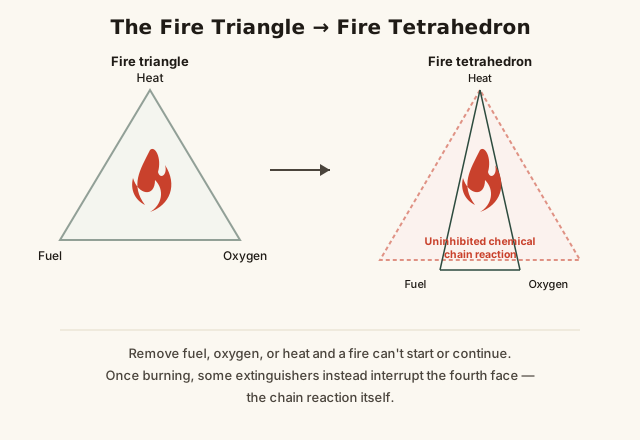
The three outer faces of the tetrahedron are the classic fire triangle — remove any one of fuel, oxygen, or heat, and a fire can't start or continues can't continue. The fourth, less obvious face is the ongoing chemical chain reaction itself: some extinguishing agents, like certain dry-chemical suppressants used in kitchen and vehicle fire extinguishers, work by interrupting that chain reaction directly rather than by removing fuel, oxygen, or heat at all.
Common mistakes
Common Mistakes
Believing water is always the correct way to put out any fire.
→ Water works well on ordinary combustibles like wood or paper, but it can make burning-oil (grease) fires and energized electrical fires significantly more dangerous — smothering or an appropriate extinguisher is the correct response for those specific fire types.
Assuming anything that looks flammable will ignite the moment it's near a flame.
→ Ignition requires enough activation energy (heat) to get the reaction started, not just proximity to fire — this is why some materials need a sustained heat source or higher temperature before they'll actually catch.
Thinking a brighter or larger-looking flame always means a hotter fire.
→ Flame color and size don't map directly onto temperature — a candle's blue base is actually hotter than its more visually prominent yellow tip, because the blue zone gets more oxygen and burns more completely.
Common misconception
“You should always use water to put out a fire, no matter what's burning.”
Which suppression method is correct depends heavily on what's actually burning. Fires involving flammable liquids and grease (often labeled Class B) can become far more dangerous with water, due to the violent steam-expansion effect of water sinking beneath hot oil and flash-boiling. Fires involving live electrical equipment (Class C) carry a shock risk if water — which conducts electricity — is used before power is cut. For any fire you're not fully confident you can safely contain with the correct method on hand, the right move is to evacuate and call emergency services rather than experiment with suppression methods.
Which of the following fire types is most likely to become more dangerous, not less, if water is poured directly onto it?
Try it yourself
What to do next
What to do next
- Next time you blow out a candle, notice you're removing heat, not just 'blowing the fire away.'
- Look at a gas stove or candle flame and try to spot the hotter blue region versus the cooler yellow-orange tip.
- Keep a metal lid or baking soda near your stovetop as the correct response to a small grease fire, and know that any fire you're not fully confident containing safely means evacuating and calling emergency services instead.
- Read the related entry on Chemical Reactions & Everyday Chemistry to see how combustion fits into the broader picture of exothermic reactions.