 KnowThis
Key Takeaways
Key Takeaways
- 1Halloween's roots trace to the ancient Celtic festival of Samhain, marking the end of the harvest and start of winter, and to the Christian feast of All Saints' Day — the name itself comes from "All Hallows' Eve," per Britannica and the Library of Congress.
- 2Familiar customs have their own separate, traceable histories: jack-o'-lanterns come from British Isles turnip-carving folklore, and trick-or-treating grew out of a much older door-to-door practice tied to praying for the dead.
- 3Halloween became the highly commercial, costume-and-candy holiday familiar in the US largely after 19th-century Irish immigration brought Samhain-descended traditions to America, where the practice of trick-or-treating became widely codified in the 1920s, per the Library of Congress.
The concept
That layered history — a Celtic harvest festival, a Christian feast day, and specific American immigration-era adaptations — is worth keeping in mind before looking at how the holiday plays out in practice today.
According to Britannica and the Library of Congress, what are Halloween's main historical roots?
Worked examples
Example 1: A typical American Halloween night (baseline case)
Example 2: Día de los Muertos in Mexico and beyond (a distinct, related exception)
Example 3: Halloween as a global commercial holiday today (real-world / applied case)
How does Día de los Muertos (Day of the Dead) relate to Halloween?
How it works (visual)
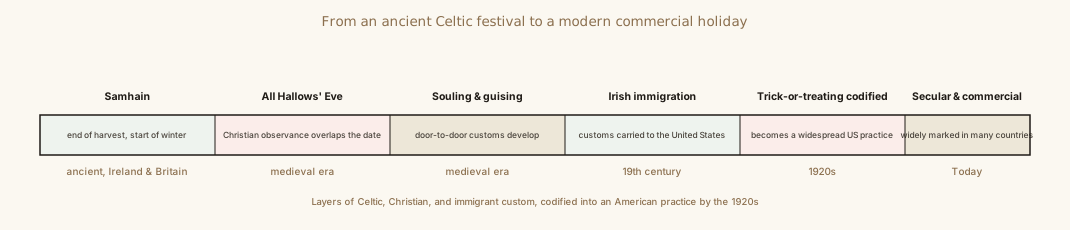
Set out this way, Halloween reads as a holiday built in layers over many centuries, rather than a single invention — a pattern that shows up across a lot of modern celebrations once you look at their documented history.
Common mistakes
Common Mistakes
Assuming Halloween is a purely American invention with no older roots.
→ Its roots trace back to the Celtic festival of Samhain and the Christian feast of All Hallows' Eve in Ireland and the British Isles, long before it took its familiar commercial shape in the US.
Treating trick-or-treating as though it has always existed in its current costumed-candy-exchange form.
→ It evolved from older souling and guising practices and only became a widely codified American practice in the 1920s, per the Library of Congress.
Conflating Halloween with Día de los Muertos (Day of the Dead) as if they're the same holiday.
→ They fall around the same time of year and both concern honoring the dead, but per the Library of Congress they have distinct religious and cultural origins and separate traditions.
Common misconception
“Halloween is purely an American commercial holiday with no older cultural or religious roots.”
Britannica and the Library of Congress both document Halloween as descending from the ancient Celtic festival of Samhain and the Christian feast of All Hallows' Eve (the vigil before All Saints' Day), practiced in Ireland and the British Isles centuries before the holiday existed in America at all. The costume-and-candy commercial form familiar in the US today is a real, and much more recent, layer — trick-or-treating became widely codified there only in the 1920s — but it sits on top of much older cultural and religious history, not in place of it.
Which best describes the documented relationship between Samhain and modern Halloween?
What to do next
What to do next
- Next time you carve or see a jack-o'-lantern, remember the tradition started with carved turnips in the British Isles, not pumpkins — pumpkins were an American adaptation.
- When trick-or-treating comes up, notice that its costumed, door-to-door candy-exchange form is a 1920s-era American development, layered on top of much older souling and guising customs.
- If you see Halloween and Día de los Muertos displayed or discussed together, notice whether the source treats them as the same holiday or as related-but-distinct traditions — the second is the historically accurate framing.
- Notice how Halloween's spread to countries with no historical Samhain or All Hallows' Eve tradition of their own reflects a distinctly modern, commercial layer of the holiday's history.