A harvest festival marks the end of a growing season with gratitude, food, and community gathering — but because crops ripen at different times in different places, each culture's harvest festival falls on its own local calendar, not one shared date.
Reading time
— 4 min
Updated
— Aug 16, 2026
Fact-reviewed
— Aug 16, 2026
Key Takeaways
Key Takeaways
1Harvest festivals exist on nearly every continent, each timed to that region's own local crop cycle — there is no single global 'harvest season' they all share.
2American Thanksgiving is one well-known example, not the template — Chuseok (Korea), Sukkot (Jewish tradition), the Mid-Autumn Festival (China and Vietnam), Pongal (South India), and Erntedankfest (Germany) are independent traditions with their own histories.
3The common thread is gratitude for a successful harvest expressed through food, family gathering, and ritual — the specific crop, date, and religious framing differ by culture.
The concept
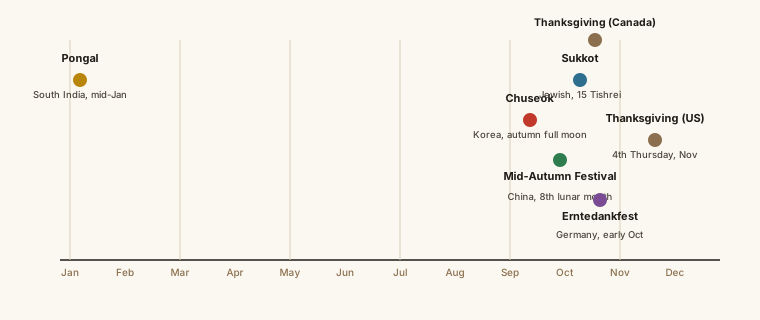
A harvest festival celebrates the end of a growing season — gathering the year's crops and giving thanks before winter or a dry season sets in. Because crops ripen at different times around the world, harvest festivals fall on different dates: American and Canadian Thanksgiving in November/October, Chuseok in Korea around the September or October full moon, Sukkot in the Jewish calendar in autumn, and Pongal in South India in mid-January, tied to that region's own rice harvest. Despite the different dates and rituals, the underlying idea — food, family, and gratitude at the close of a growing season — repeats across all of them.
Quick check
Why don't harvest festivals around the world fall on the same date?
Worked examples
Example 1: American Thanksgiving — a fixed civil-calendar harvest festival (baseline case)
Thanksgiving is fixed by U.S. federal law to the fourth Thursday of November, a date set in 1941 (earlier Thanksgivings floated somewhat by presidential proclamation). Its popular origin story centers on a 1621 harvest celebration shared by Plymouth colonists and Wampanoag people, though the holiday's modern form — turkey, family gathering, football — developed gradually over the following centuries and was formalized as a national holiday during the Civil War. Canada observes its own Thanksgiving on the second Monday of October, reflecting an earlier harvest season at that latitude.
Example 2: Chuseok — a lunar-calendar harvest festival centered on ancestral rites (variation)
Chuseok, one of Korea's two most important holidays, falls on the 15th day of the 8th lunar month — the full moon nearest the region's rice and staple crop harvest, usually landing in September or early October on the Gregorian calendar. Unlike Thanksgiving's meal-centered focus, Chuseok's core ritual is charye, a formal ancestral memorial rite performed with freshly harvested food, followed by family gathering and eating songpyeon, half-moon-shaped rice cakes. The holiday typically spans three days and involves one of the largest domestic travel surges in Korea each year, as families return to ancestral hometowns — a structural difference from Thanksgiving's single-day observance.
Example 3: Pongal — a harvest festival tied to a specific regional crop window (real-world / applied case)
Pongal, a four-day Tamil harvest festival in South India, falls in mid-January — months apart from the autumn harvest festivals common in temperate climates — because it marks the region's own rice harvest and the sun's movement into Capricorn (Makar Sankranti in broader Indian usage). The festival's name comes from the ritual of boiling fresh rice with milk and jaggery until it overflows the pot, a literal, visible symbol of abundance. Pongal demonstrates the core logic of harvest festivals cleanly: the date follows the crop, not a shared international harvest season, which is why a harvest festival in South India and one in North America can be nearly opposite each other on the calendar.
Quick check
What is the central ritual of Sukkot?
Harvest festivals plotted across the year by hemisphere and crop cycle
Common mistakes
Common Mistakes
✕
Assuming all harvest festivals fall in Western autumn (September to November).
→ Pongal falls in mid-January because it follows South India's own rice harvest — harvest festival timing follows local crop cycles, not one shared season.
✕
Treating American Thanksgiving as the model other harvest festivals are compared against.
→ Chuseok, Sukkot, Pongal, and the Mid-Autumn Festival are independent traditions, most considerably older than the American holiday, each with distinct rituals and origin stories of their own.
✕
Assuming a harvest festival is purely secular or purely religious across all cultures.
→ The mix varies — Sukkot is explicitly religious with a biblical basis, Chuseok centers on ancestral rites, and modern American Thanksgiving is largely civil/secular despite its harvest-meal origin.
Common misconception
“Harvest festivals are an outdated agrarian tradition with no real relevance to modern, largely non-farming societies.”
Harvest festivals remain among the most widely observed holidays globally precisely because they were reframed around gratitude, family, and community rather than literal participation in farming — Thanksgiving, Chuseok, and Sukkot are all major modern holidays in societies where most people have no direct connection to agriculture. The ritual outlasted the agrarian economy that produced it by shifting its meaning, not by staying frozen as a farming custom.
Quick check
Which statement best reflects how harvest festivals function in most modern societies?
What to do next
What to do next
Next time you hear 'harvest festival,' ask which region and crop it's tied to — the term covers dozens of independent traditions, not one global event.
Notice whether a given harvest festival follows a lunar date (Chuseok, Sukkot, Mid-Autumn Festival) or a fixed civil date (Thanksgiving, Erntedankfest) — it explains why the Gregorian date moves or stays put year to year.
If a harvest festival's date seems to fall 'out of season' relative to your own hemisphere or region, check what crop and climate it's actually tied to before assuming it's an error.
Look up which harvest festivals, if any, are observed in your own region's history — many places have older, more localized harvest customs that predate the internationally famous examples.
FAQ
FAQ
Related terms
Related terms
Harvest festival
A celebration marking the end of a growing season, typically involving food, gratitude rituals, and community gathering, timed to a specific crop's local harvest rather than one shared calendar date.
Sukkot
A seven-day Jewish harvest festival, also called the Feast of Tabernacles, during which families build and eat meals in a temporary outdoor shelter called a sukkah.
Chuseok
A major Korean harvest festival held on the 15th day of the 8th lunar month, centered on ancestral rites, family gathering, and sharing songpyeon rice cakes.
 KnowThis