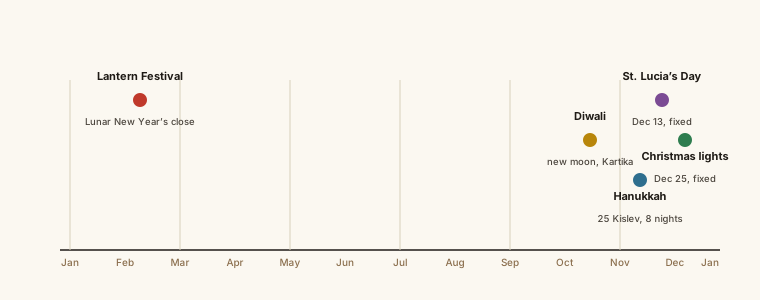
Across unrelated cultures and religions, a recurring human pattern shows up every year: lighting flames or lanterns to mark a turn from darkness toward light, at whatever point in the calendar that culture's own tradition places it.
Reading time
— 5 min
Updated
— Aug 16, 2026
Fact-reviewed
— Aug 16, 2026
Key Takeaways
Key Takeaways
1Diwali, Hanukkah, Christmas lights, the Chinese Lantern Festival, and St. Lucia's Day are independent traditions, not variations on one 'original' festival of light — each has its own religious or cultural origin story.
2Most (though not all) of these fall in the darker months of the Northern Hemisphere's year, which is why the pattern feels so consistent — but the specific date in each tradition is set by that tradition's own calendar, not a shared one.
3The common thread across all of them is symbolic, not historical borrowing: light standing in for hope, protection, remembrance, or renewal at a point in the year when daylight is genuinely scarce.
The concept
All over the world, different cultures independently light lamps, candles, or lanterns as the centerpiece of a major festival. Diwali lights oil lamps across India in October or November. Jewish communities light a menorah for the eight nights of Hanukkah, usually in December. Christmas lights fill streets and homes worldwide in the same month. In China and across East Asia, the Lantern Festival closes out Lunar New Year with glowing paper lanterns in January or February. None of these festivals borrowed the idea from one another — they developed separately, each with its own story, and each landing at a different point on the calendar.
Quick check
Why do so many unrelated festivals of light cluster in the darker months of the year?
Worked examples
Example 1: Diwali — a lunar-calendar festival of light (baseline case)
Diwali falls on the new-moon night of the Hindu month of Kartika, typically in October or November, and its date shifts on the Gregorian calendar every year because it follows a lunisolar system. Families light rows of small oil lamps called diyas along windowsills and doorways, a practice most commonly traced to the story of Rama, Sita, and Lakshmana's return to Ayodhya, when villagers are said to have lit lamps to welcome them home. The lamps symbolize light overcoming darkness and good overcoming evil — a theme distinct to Diwali's own religious narrative, unconnected to any other light festival on this list.
Example 2: Hanukkah — a fixed ritual sequence with its own historical anchor (variation)
Hanukkah commemorates a specific historical and legendary event: the 2nd-century BCE rededication of the Second Temple in Jerusalem after its recapture during the Maccabean Revolt, and the legend that a single day's supply of oil miraculously burned for eight days. Rather than a single night of lamp-lighting, Hanukkah unfolds over eight nights, with one additional candle lit on a nine-branched menorah (the ninth candle, the shamash, is used to light the others) each night. This is a meaningfully different structure from Diwali's single main lighting night — the same broad symbol (light overcoming a hostile darkness) but built around its own historical narrative and its own multi-night ritual calendar.
Example 3: Christmas lights and the Lantern Festival — light as public, secular-adjacent spectacle today (real-world / applied case)
Two traditions show how a festival of light can extend well beyond its original religious core into shared public culture. Christmas lighting displays — string lights on houses, public tree-lighting ceremonies, department-store window displays — are now a fixture of December in many countries regardless of individual residents' religious practice. Separately, the Lantern Festival, which closes out Lunar New Year across China, Taiwan, Vietnam, and other East Asian communities, has become a major public spectacle in cities worldwide, with large-scale lantern displays drawing visitors who aren't marking the holiday religiously at all. In both cases, a specific tradition's light imagery has become recognizable and enjoyed on a much broader scale than its original observant community — a pattern also visible in how Diwali light displays are increasingly part of public celebrations in cities with large diaspora communities.
Quick check
Which of these is true of Hanukkah's timing and structure?
When five festivals of light fall across the year, and why each date is set independently
Common mistakes
Common Mistakes
✕
Treating Diwali as 'the' festival of light and everything else as a variant of it.
→ Diwali, Hanukkah, Christmas lighting customs, the Lantern Festival, and St. Lucia's Day are independent traditions with separate origins — each is a full example of the same human pattern, not a spinoff of any one of them.
✕
Assuming all festivals of light happen at the winter solstice.
→ Some do cluster near the solstice (Christmas lights, St. Lucia's Day), but Diwali and the Lantern Festival follow lunar calendars unrelated to the solstice and can fall well outside that window.
✕
Calling Hanukkah 'the Jewish Christmas.'
→ Hanukkah commemorates a distinct historical and legendary event (the Maccabean Revolt and the temple oil legend) and is a comparatively minor holiday on the Jewish religious calendar — its cultural prominence in Western countries comes from calendar proximity to Christmas, not equivalent religious status.
Common misconception
“Festivals of light are a uniquely Hindu or Diwali-specific tradition that other cultures have picked up or adapted.”
Lighting flames or lanterns as a central festival act developed independently across Hindu, Jewish, Christian, Chinese, and Scandinavian traditions, among others, each with its own origin story and calendar logic. Diwali is one well-documented example of this broader human pattern, not the source of it — there is no evidence any of these traditions borrowed the practice from another.
Quick check
What's the most accurate way to describe the relationship between Diwali, Hanukkah, and Christmas lights?
What to do next
What to do next
Next time you see a 'festival of light' described in the news or on social media, check which specific tradition is meant — the phrase covers several unrelated observances, not one event.
Notice the calendar system behind whichever light festival is being discussed — lunar (Diwali, Lantern Festival), lunisolar Hebrew (Hanukkah), or fixed Gregorian (St. Lucia's Day, Christmas) — it explains why the date moves or stays fixed year to year.
If you're attending a light festival celebration outside your own background for the first time, ask what the lighting specifically commemorates in that tradition rather than assuming it maps onto one you already know.
Look up this year's dates for Diwali and Hanukkah in particular — both shift on the Gregorian calendar annually, unlike Christmas or St. Lucia's Day.
FAQ
FAQ
Related terms
Related terms
Festival of light
A general term for any celebration built around lamps, candles, lanterns, or bonfires as its central symbolic act — not a single tradition, but a pattern that recurs independently across many cultures.
Menorah / Hanukkiah
The nine-branched candelabrum lit one additional candle each night during Hanukkah's eight nights, using a ninth 'helper' candle (the shamash) to light the others.
Lantern Festival
The Chinese and broader East Asian festival marking the close of Lunar New Year celebrations, observed by displaying and releasing paper lanterns.
 KnowThis