New Year celebrations mark the start of a new annual cycle, but because different cultures use different calendar systems, there is no single universal New Year date — January 1, Lunar New Year, Nowruz, and Rosh Hashanah are among several independently calculated New Year observances.
Reading time
— 5 min
Updated
— Aug 16, 2026
Fact-reviewed
— Aug 16, 2026
Key Takeaways
Key Takeaways
1January 1 is the New Year date on the Gregorian calendar, the internationally standard civil calendar — but it isn't the only New Year date observed worldwide.
2Lunar New Year, Nowruz, and Rosh Hashanah are independent New Year traditions calculated on entirely different calendar systems, each with its own historical and religious basis.
3Many cultures observe both a Gregorian January 1 New Year for civil/secular purposes and a separate cultural or religious New Year on their own calendar — the two aren't mutually exclusive.
The concept
New Year celebrations mark the start of a new annual cycle, but the date depends entirely on which calendar system a culture uses. January 1 is New Year's Day on the Gregorian calendar, the civil calendar used internationally for business, government, and daily life in most countries. But Lunar New Year in China and across East and Southeast Asia falls on a different date each year based on the moon, usually late January to mid-February. Nowruz, the Persian New Year, is fixed to the March equinox. Rosh Hashanah, the Jewish New Year, falls in September or early October on the Hebrew calendar. These are independent traditions, not variants of the January 1 date.
Quick check
Why doesn't Lunar New Year fall on the same Gregorian date every year?
Worked examples
Example 1: January 1 on the Gregorian calendar (baseline case)
Most of the world marks New Year's Eve and New Year's Day around January 1 on the Gregorian calendar, typically with countdown events, fireworks, and celebrations tied to a specific midnight moment in each time zone — meaning New Year's technically arrives at 24 different points around the globe as time zones cross midnight in sequence. This is a civil and largely secular observance globally, distinct from any single religious tradition, which is part of why it's so widely shared across countries with otherwise very different calendars and cultural New Year traditions of their own.
Example 2: Lunar New Year — a lunisolar new year observed with regional variation (variation)
Lunar New Year falls on the second new moon after the winter solstice, typically landing between late January and mid-February, and is observed across China (as Chinese New Year or the Spring Festival), Korea (Seollal), and Vietnam (Tết), each with shared lunisolar timing but distinct regional customs, foods, and rituals. In China specifically, it's the most significant holiday of the year, marked by a weeks-long travel period as families reunite, red envelopes of money given to children, and public displays like lion dances and fireworks — a genuinely different scale and character from a January 1 countdown celebration.
Example 3: Rosh Hashanah — a religious New Year observed alongside the civil calendar (real-world / applied case)
Rosh Hashanah, the Jewish New Year, is observed on 1–2 Tishrei in the Hebrew calendar, typically falling in September or early October on the Gregorian calendar, and marks the start of the Ten Days of Repentance leading to Yom Kippur. It's a religious observance — marked by prayer services, the sounding of the shofar (a ram's horn), and symbolic foods like apples dipped in honey for a sweet new year — observed by Jewish communities worldwide alongside, not instead of, the Gregorian calendar most of those same communities use for civil and business purposes the rest of the year. This dual observance pattern (a religious or cultural New Year alongside the Gregorian one) is common, not unusual, across many of the traditions in this list.
Quick check
What does Rosh Hashanah mark the beginning of?
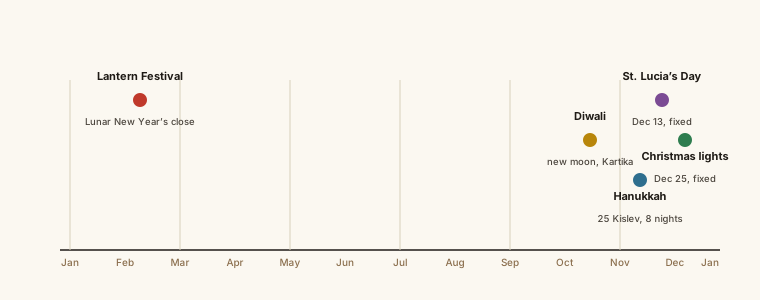
Four New Year traditions plotted across the year, each on its own calendar system
Common mistakes
Common Mistakes
✕
Assuming January 1 is the universal New Year date across all cultures.
→ January 1 is the Gregorian civil calendar's New Year date, but Lunar New Year, Nowruz, and Rosh Hashanah are independently calculated New Year traditions on entirely different calendar systems.
✕
Treating Lunar New Year as a single, uniform holiday with no regional variation.
→ The lunisolar timing is shared, but Chinese New Year, Korea's Seollal, and Vietnam's Tết are distinct national traditions with their own specific customs, foods, and rituals.
✕
Assuming a culture observing a religious or cultural New Year doesn't also mark January 1.
→ Many communities observe both — for example, mainland China uses the Gregorian calendar administratively while treating Lunar New Year as its most culturally significant holiday of the year.
Common misconception
“New Year's Day falls on January 1st universally across all cultures and calendars.”
January 1 is the New Year's Day of the Gregorian calendar specifically, which is used as the international civil standard — but Lunar New Year, Nowruz, and Rosh Hashanah are independently calculated New Year traditions on lunisolar, equinox-based, and Hebrew calendar systems respectively, each falling on its own distinct date most years. Many cultures mark more than one of these New Year dates, rather than treating January 1 as a replacement for their own tradition.
Quick check
Which statement most accurately reflects how New Year celebrations work globally?
What to do next
What to do next
Next time you see 'New Year' mentioned, check which calendar system and culture it refers to — January 1, Lunar New Year, Nowruz, and Rosh Hashanah are all genuinely different dates.
Notice whether a culture you're learning about observes a dual New Year pattern — a civil Gregorian one plus a separate cultural or religious one — rather than assuming one replaces the other.
If you're wishing someone a happy Lunar New Year, Nowruz, or Rosh Hashanah, check this year's specific date — unlike January 1, all three move on the Gregorian calendar from year to year.
Look up which New Year traditions, if any, are observed in your own family or regional background beyond January 1.
FAQ
FAQ
Related terms
Related terms
Gregorian calendar
The internationally standard civil calendar, introduced in 1582 and now used worldwide for secular and administrative purposes, which sets New Year's Day on January 1.
Lunar New Year
The new year celebration observed in China and across East and Southeast Asia, timed to the second new moon after the winter solstice — commonly falling between late January and mid-February.
Rosh Hashanah
The Jewish New Year, marking the start of the High Holy Days, observed on 1–2 Tishrei in the Hebrew calendar, typically falling in September or early October.
 KnowThis