 KnowThis
Key Takeaways
Key Takeaways
- 1The first Earth Day was held on April 22, 1970, in the United States — founded by US Senator Gaylord Nelson of Wisconsin after witnessing the aftermath of the 1969 Santa Barbara oil spill, per Encyclopaedia Britannica.
- 2More than 20 million people took part in that first Earth Day, and per the National Archives, it helped build the political momentum behind the creation of the US Environmental Protection Agency (EPA) later in 1970, along with a wave of federal environmental laws through the 1970s.
- 3Earth Day did not start out as an international observance — Britannica documents its expansion into a global event only by 1990 — and today, per the National Archives, it's marked by roughly a billion people across nearly 200 countries each year.
The concept
That single-country-to-global trajectory — a specific 1970 founding, then international expansion decades later — turns out to be a pattern worth recognizing, since it shows up in several other modern awareness days as well.
Who founded Earth Day, and what prompted it, per Encyclopaedia Britannica?
Worked examples
Example 1: The first Earth Day, April 22, 1970 (baseline case)
Example 2: Earth Day goes global, 1990 (a genuine turning point)
Example 3: Earth Day today, alongside other awareness days (real-world / applied case)
When did Earth Day become an internationally observed event, according to Britannica?
How it works (visual)
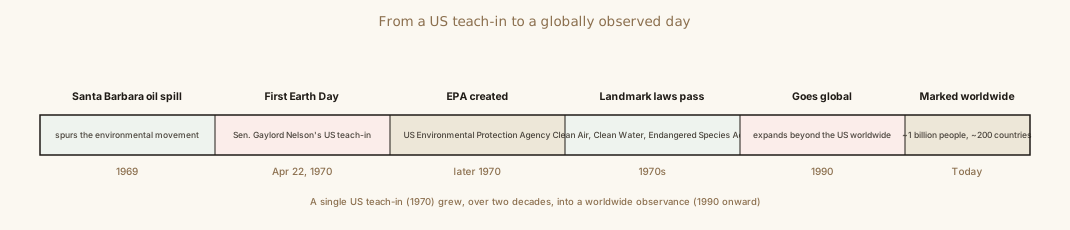
Set out this way, Earth Day's history reads as a clear two-stage story — a specific US founding, then a later, separate expansion into a global observance — rather than one single, unified moment.
Common mistakes
Common Mistakes
Assuming Earth Day was founded as an international event from the start.
→ It began in 1970 as a single-country US observance, founded by Senator Gaylord Nelson, and only became internationally observed in 1990, per Britannica.
Treating Earth Day and the founding of the EPA as the same event.
→ They're distinct. The EPA was created by President Nixon later in 1970 as a documented political consequence of the momentum Earth Day built, not as part of Earth Day itself.
Assuming every modern awareness day shares Earth Day's exact origin story.
→ Earth Day's US-founding-then-global-expansion pattern is common, but each awareness day has its own separate founding date, founder(s), and history — they shouldn't be assumed identical.
Common misconception
“Earth Day has always been an internationally observed day since a single unified founding moment.”
Earth Day began as a single-country event: Senator Gaylord Nelson organized the first Earth Day on April 22, 1970, as a nationwide US environmental teach-in, per Encyclopaedia Britannica. It was not observed internationally at that point. Britannica documents its expansion into a globally observed event only in 1990, two decades after its US founding — meaning today's worldwide observance is the result of a later, separate expansion, not a single unified global founding moment.
What does the documented history show about Earth Day's path to becoming a global observance?
What to do next
What to do next
- Next time you see Earth Day described as an ancient or always-global tradition, remember it has a specific, documented 1970 founding by one US senator.
- If you hear Earth Day and the EPA's founding described as the same event, note that they're distinct — the EPA came later in 1970, as a political consequence of Earth Day's momentum.
- When another 'awareness day' comes up, ask when and where it actually started — Earth Day's US-then-global pattern is common, but each day has its own separate history.
- Notice how Earth Day's founding is tied to a specific environmental event, the 1969 Santa Barbara oil spill — a reminder that many awareness days trace to a concrete triggering event, not just an abstract cause.