 KnowThis
Key Takeaways
Key Takeaways
- 1Every unit conversion, regardless of category, is the same operation: multiply the original value by a fixed conversion factor that expresses the relationship between the two units.
- 2The metric system's units relate to each other by clean powers of ten, while US customary units use irregular, historically inherited ratios (12 inches per foot, 3 feet per yard) that must be memorized or looked up.
- 3Rounding a conversion factor too early or too aggressively compounds into meaningful error over large values — a small per-unit rounding error scales with the size of the number being converted.
The concept
Knowing that every conversion boils down to "multiply by a fixed factor" is the easy part — the more useful skill is getting comfortable with a handful of the conversion factors that come up constantly in everyday situations.
A recipe lists an oven temperature in Celsius, but your oven only displays Fahrenheit. Is converting Celsius to Fahrenheit the same kind of operation as converting miles to kilometers?
Worked examples
Example 1: Converting a length from miles to kilometers (baseline case)
Example 2: A multi-step conversion using dimensional analysis (edge case / variation)
Converting 60 miles per hour to meters per second requires multiplying by both a distance factor (miles to meters) and a time factor (hours to seconds). Why is checking that the units cancel out important?
Example 3: Why rounding a conversion factor early causes real error at scale (real-world / applied case)
How it works (visual)
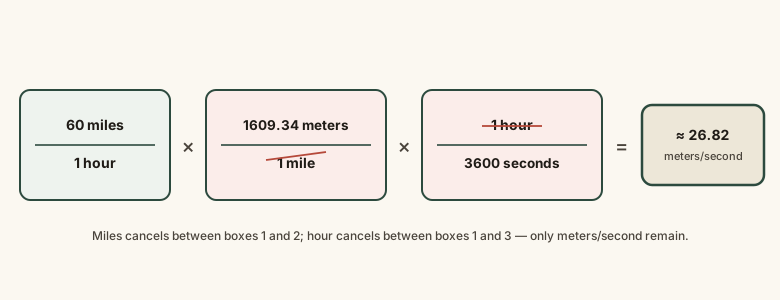
Reading left to right, each fraction is deliberately arranged so its denominator cancels a unit from the previous fraction's numerator — miles cancels with miles, hours cancels with hours — leaving only meters (top) and seconds (bottom) standing at the end of the chain. This visual cancellation is the entire safeguard behind dimensional analysis: if a fraction had been flipped upside down, the wrong units would remain at the end instead of canceling cleanly, immediately signaling a setup mistake.
Common mistakes
Common Mistakes
Multiplying by a conversion factor when you should be dividing (or vice versa).
→ Sanity-check the direction with a rough estimate first — converting a small number of miles should give a slightly larger number of kilometers, not a smaller one, since a kilometer is a shorter unit than a mile.
Using an overly rounded conversion factor for a large-scale or high-precision conversion.
→ Use the full-precision conversion factor (or at least several decimal places) whenever the quantity being converted is large — small per-unit rounding error scales up with the size of the number.
Treating temperature conversion (Celsius to Fahrenheit) as a simple multiplication like length or weight conversions.
→ Remember temperature conversion requires an added offset, not just a multiplication, because Celsius and Fahrenheit don't share the same zero point.
Common misconception
“All unit conversions work the same simple way, so the same 'multiply by a factor' shortcut applies to literally any measurement, including temperature.”
Length, weight, and volume conversions are pure multiplications by a fixed factor because both units in the pair measure zero identically — zero miles is the same physical amount as zero kilometers. Temperature is the major exception: Celsius and Fahrenheit assign different numbers to the same physical zero point (0°C is 32°F, not 0°F), so converting between them requires both a multiplication and an added offset, not a multiplication alone.
Someone tries to convert 20°C to Fahrenheit by simply multiplying by 1.8 (getting 36°F), without adding anything. What's wrong with this approach?
Try it yourself
What to do next
What to do next
- Memorize a handful of everyday conversion factors you actually use (miles to kilometers, pounds to kilograms, cups to milliliters) rather than looking them up every time.
- Next time you do a multi-step conversion, write out the chain of fractions and check that the unwanted units visibly cancel before trusting the final number.
- Use the calculator above with the full-precision conversion factor rather than a rounded one, especially for anything involving large quantities.
- Remember that Celsius-to-Fahrenheit (and vice versa) needs an added offset, not just a multiplication — it's a genuine exception to the 'multiply by a factor' rule.