Math in Cooking (measurement conversions, scaling recipes)
Scaling a recipe multiplies every ingredient by the same ratio of desired-to-original servings, but volume-to-weight conversions and cooking time depend on ingredient density and heat transfer, not on that same ratio.
Reading time
— 6 min
Updated
— Aug 16, 2026
Fact-reviewed
— Aug 16, 2026
Key Takeaways
Key Takeaways
1Scaling a recipe means multiplying every ingredient by the same scale factor (desired servings ÷ original servings) — but not everything in a recipe scales at that same rate.
2A volume measurement like 'one cup' converts to a different weight for every ingredient, because different ingredients pack at different densities — a cup of flour and a cup of sugar are not the same number of grams.
3Cooking and baking time do not scale linearly with quantity, because heat has to physically penetrate the food, and that process slows disproportionately as thickness or volume increases.
The concept
Scaling a recipe up or down is a ratio problem: if a recipe serves 4 and you want to serve 10, multiply every ingredient by 10 ÷ 4 = 2.5. A cup of flour becomes 2.5 cups; a teaspoon of salt becomes 2.5 teaspoons. Measurement conversions are separate but related — recipes mix volume units (teaspoons, tablespoons, cups) and sometimes weight units (grams, ounces), and converting between them cleanly requires knowing an ingredient's density, since a cup of a light, airy ingredient weighs far less than a cup of a dense one.
The scale-factor math is the easy part. The harder, more interesting part is knowing exactly which pieces of a recipe genuinely follow that ratio and which ones don't — and that split is where most scaling mistakes happen.
Quick check
A recipe uses 3 teaspoons of an ingredient. How many tablespoons is that, given that 1 tablespoon equals exactly 3 teaspoons?
Worked examples
Example 1: Scaling a recipe from 4 servings to 10 servings (baseline case)
A pancake recipe serving 4 calls for 2 cups of flour, 3 tablespoons of sugar, and 1.5 teaspoons of salt. Scale factor: 10 ÷ 4 = 2.5. Flour: 2 × 2.5 = 5 cups. Sugar: 3 × 2.5 = 7.5 tablespoons. Salt: 1.5 × 2.5 = 3.75 teaspoons. Every ingredient is multiplied by the identical 2.5 factor — this is the mechanical core of recipe scaling, and it's exactly right for flour, sugar, liquids, and most bulk ingredients.
Example 2: Converting cup measurements to grams for two different ingredients (edge case / variation)
A recipe calls for 2 cups of flour and 1 cup of sugar, but a kitchen scale is more accurate than scooped cup measurements for baking. Using commonly cited baking-reference weights, 1 cup of all-purpose flour is roughly 120 grams, so 2 cups ≈ 240 grams. 1 cup of granulated sugar is roughly 200 grams, so 1 cup ≈ 200 grams. Both started as "1 cup" in the recipe's language, but flour and sugar don't weigh the same per cup because they pack to different densities — flour's fine, aerated particles trap more air per scoop than sugar's denser granules. This is exactly why professional and serious home bakers weigh ingredients in grams rather than scoop by volume: a "cup" of flour can vary by 10-15% in actual weight depending on how firmly it's packed into the cup, while a gram is a gram regardless of technique.
Quick check
A recipe calls for 1 cup of flour and 1 cup of sugar. Do these weigh the same amount in grams?
Example 3: Why doubling a cake recipe doesn't simply double the bake time (real-world / applied case)
A single-layer cake baked in a standard pan takes 30 minutes at 350°F. Doubling the batter and pouring it into a deeper pan of the same footprint roughly doubles the batter's depth. Heat has to conduct inward from the pan's edges and top surface to fully cook the center, and that heat-penetration process depends on the square of the thickness the heat has to travel through — not on total batter volume or mass. Practically, this means the doubled, deeper cake often needs considerably more than 60 minutes (commonly 75-90 minutes, adjusted by testing with a toothpick), and if it's pulled at a naively doubled "60 minutes," the edges will be done while the center is still raw batter. The practical fix bakers use is either to keep the layer depth the same (splitting the doubled batter across two pans instead of one deeper pan) or to lower the oven temperature slightly and extend time substantially, testing doneness directly rather than trusting a doubled clock time.
How it works (visual)
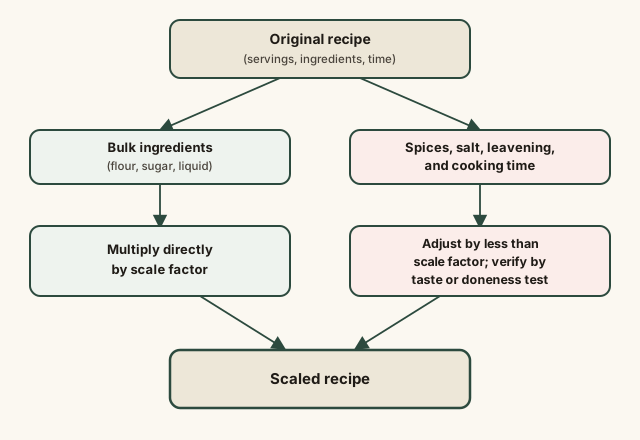
Recipe scaling flowchart: what follows the scale factor and what doesn't
The left branch — bulk ingredients like flour, sugar, and liquid — follows the scale factor exactly, because their effect on the finished dish is roughly proportional to their quantity. The right branch — spices, salt, leavening agents, and time — doesn't follow the same straight-line rule, because taste intensity, chemical leavening reactions, and heat penetration all behave nonlinearly as quantity changes. Treating every ingredient on the diagram's left branch is safe; treating everything on the right branch the same way is where most scaling mistakes happen.
Common mistakes
Common Mistakes
✕
Scaling cooking or baking time by the same factor as the ingredients.
→ Test doneness directly (toothpick test, thermometer, visual cues) instead of trusting a linearly scaled clock time — heat penetration doesn't scale the way ingredient quantity does.
✕
Treating a 'cup' measurement as interchangeable across different ingredients when converting to weight.
→ Look up (or weigh) each ingredient's specific density — a cup of flour, a cup of sugar, and a cup of butter are three different weights despite sharing the same volume.
✕
Assuming spices, salt, and leavening agents (like baking soda) scale at the exact same rate as bulk ingredients.
→ Scale these more conservatively than the straight multiplication factor and adjust to taste or test — doubling salt or baking soda exactly can easily oversalt a dish or make it taste chemically bitter.
Common misconception
“Doubling a recipe means doubling every single ingredient, including cooking or baking time, in exact proportion.”
Bulk ingredients (flour, sugar, liquid) genuinely do scale by the same straight multiplication factor. But cooking and baking time depend on heat physically penetrating the food — a process governed by thickness, not total quantity — so doubling volume in a deeper container can require far more than double the time. Similarly, salt, spices, and leavening agents are frequently scaled down slightly from the full factor because their effect on taste or chemical reaction isn't strictly linear with quantity.
Quick check
You double a soup recipe, using twice the volume of every liquid and solid ingredient in a bigger pot. Should the simmering time on the stovetop also simply double?
Try it yourself
Scale an ingredient quantity to a new number of servings
Scaled ingredient amount5
What to do next
What to do next
Try the calculator above with your own recipe's serving count and one ingredient amount to get its scaled equivalent instantly.
Next time you bake, weigh flour and sugar on a kitchen scale instead of scooping by cup, and compare how much the gram totals differ from a generic cup-to-gram assumption.
When you double a baked recipe, plan to test doneness directly (toothpick, thermometer) rather than trusting a simply-doubled clock time.
Scale salt, spices, and leavening agents a little more conservatively than the full scale factor, and adjust to taste after cooking.
FAQ
FAQ
Related terms
Related terms
Scale factor
The ratio of a new quantity to an original quantity — desired servings divided by original servings — used to resize every ingredient in a recipe consistently.
Density
Mass per unit of volume; the reason a cup of flour and a cup of sugar don't weigh the same amount even though they fill the same-sized cup.
US customary cup
A volume unit equal to 236.588 milliliters, standard in U.S. recipes — distinct from the 250 mL 'metric cup' used in Australia, the UK, and elsewhere.
Thermal diffusion
The process by which heat spreads through a material over time; it's the reason thicker or larger portions of food take disproportionately longer to cook through, not just proportionally longer.
 KnowThis