 KnowThis
Key Takeaways
Key Takeaways
- 1A percentage is just 'per hundred' — converting a percent to a decimal (divide by 100) is the one step that makes every discount, tax, and tip calculation simple.
- 2Applying multiple percentages in sequence, like a discount followed by tax, is multiplicative, not additive — a 30% discount followed by 8% tax is not the same as a flat 22% off.
- 3Tax is added to a price, a discount is subtracted from it, and a tip is conventionally calculated on the pre-tax subtotal — mixing up which base a percentage applies to is the most common way people miscalculate a total.
The concept
That compounding behavior — each percentage acting on the result of the last one, not the original number — is the single biggest source of real-world percentage mistakes, and it's worth testing against your own intuition before walking through the arithmetic.
A $100 item gets 20% off, and then a 20% coupon is applied to the already-discounted price. Is the final price the same as taking a flat 40% off the original $100?
Worked examples
Example 1: Calculating a single discount (baseline case)
Example 2: Discount followed by tax — why percentages compound instead of adding (edge case / variation)
A $40 shirt is 50% off, and then an extra 50% off is applied to the already-discounted sale price. What is the final price — free, $10, or $20?
Example 3: Tipping on the pre-tax vs. post-tax amount (real-world / applied case)
How it works (visual)
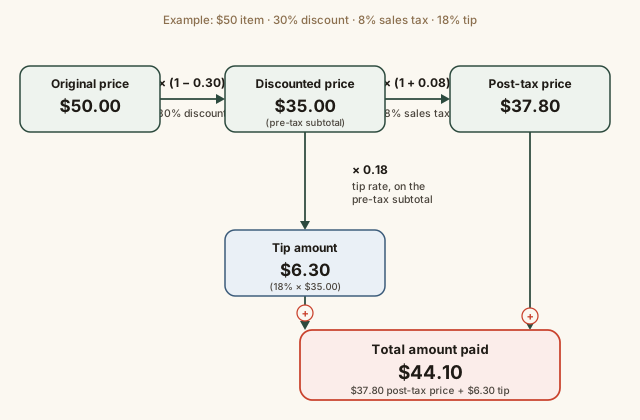
Each arrow in the flow represents multiplying by a factor built from a percentage, and the key detail is that every arrow acts on the box directly before it, not on the original starting box. That's the visual version of "percentages compound, they don't add" — tracing the diagram left to right is the same sequence of steps worked out numerically in Example 2 and Example 3.
Common mistakes
Common Mistakes
Adding or subtracting percentages directly instead of applying them one at a time in sequence (treating 30% off then 8% tax as a flat 22% off).
→ Apply each percentage as its own multiplication step, in the actual order it happens, to whatever amount exists at that point — not to the original price each time.
Confusing 'percentage' with 'percentage point,' especially when reading about a rate change (a tax rate rising from 5% to 6%).
→ A change from 5% to 6% is a 1 percentage point increase, but a 20% relative increase in the rate itself. Check which one a headline or claim actually means before repeating it.
Assuming two equal successive discounts add up to their sum (two 50%-off discounts making an item free).
→ Each discount applies to the price left after the previous one. Work it step by step: $40 × 0.5 = $20, then $20 × 0.5 = $10 — 75% off total, not 100%.
Common misconception
“An item that's 50% off, with an extra 50% off on top, ends up free.”
Stacked percentage discounts multiply against the price remaining after each step, they don't add up to their sum. A $40 item at 50% off becomes $20; applying the second 50% off to that new $20 price gives $10, not $0. Two stacked 50%-off discounts equal 75% off in total — a real and generous discount, but nowhere near free. The same multiplicative logic is exactly why a 100%-off-equivalent claim ("buy one get one free," described as "50% off two items") is genuinely 50% off, while two separate 50%-off coupons stacked on one item is not.
A store advertises 'Take an extra 50% off already-reduced clearance prices.' A jacket's clearance price is already 50% off the original $120. What is the final price?
Try it yourself
What to do next
What to do next
- Next time a receipt shows a discount and tax together, work out each step separately (discount first, then tax on the new amount) instead of subtracting the two rates.
- Try the calculators above with your own numbers from a recent purchase and check the total against your actual receipt.
- Before splitting a restaurant bill, decide as a group whether the tip is on the pre-tax or post-tax amount — the difference is usually small but avoids a mismatched total.
- Read the related entry on Percentages Explained for the underlying fraction-decimal-percent conversions this entry builds on.