 KnowThis
Key Takeaways
Key Takeaways
- 1Probability is favorable outcomes divided by total possible outcomes — a number between 0 (impossible) and 1 (certain), often written as a percentage.
- 2Independent events, like separate coin flips or dice rolls, have no memory of past outcomes — five heads in a row doesn't make tails any more likely on the sixth flip.
- 3The probabilities of every possible outcome in a sample space always add up to exactly 1 (100%), which is a fast way to sanity-check a probability calculation.
The concept
That gap between what feels intuitively true and what the math actually says is where probability trips people up most — and nowhere more than the belief that a random process can somehow "remember" what it did last.
A fair coin has landed on heads 5 times in a row. What is the probability it lands on heads on the 6th flip?
Worked examples
Example 1: Rolling a specific number on a die (baseline case)
Example 2: Independent vs. dependent events (edge case / variation)
You draw one card from a full deck, don't replace it, then draw a second card. Why can't you calculate P(both draws are hearts) the same way you would for two separate coin flips?
Example 3: What a "30% chance of rain" forecast actually means (real-world / applied case)
A weather forecast showing "30% chance of rain" isn't saying it will rain for 30% of the day, or that 30% of the region will get wet. Meteorologists define it as the probability of precipitation (PoP): under historical atmospheric conditions closely matching today's setup, measurable rain occurred at the forecast location roughly 30% of the time. It's an experimental probability built from pattern-matching against a large historical record, not a guarantee — much like a die showing 1/6 doesn't promise a 1 will show up once every six rolls, only that it will trend toward that rate across many rolls. A 30% forecast that turns out rainy isn't "wrong" any more than rolling a 6 twice in a row is proof a die is broken.
How it works (visual)
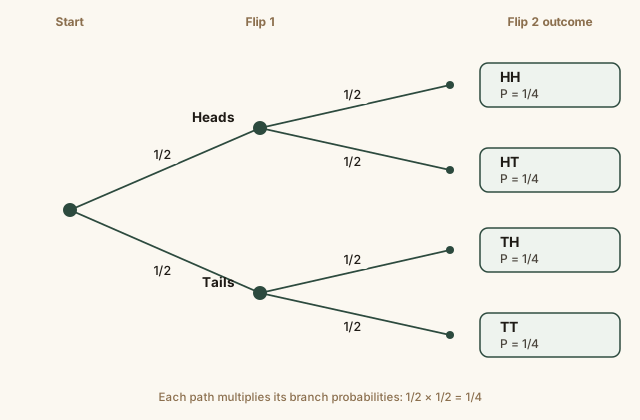
Each branch point represents one flip, and multiplying probabilities along a path from start to end gives that specific outcome's probability — 0.5 × 0.5 = 0.25 for each of the four paths shown. Because the tree captures every possible outcome exactly once, the four end-branch probabilities add up to exactly 1, which is the same sample-space check used in Example 1. This branching structure is the general tool for working out probabilities of multiple independent events in sequence, no matter how many steps are involved.
Common mistakes
Common Mistakes
Believing a random process 'owes' a different outcome after a streak (the gambler's fallacy).
→ For truly independent events, past outcomes have zero effect on future ones. A coin, die, or roulette wheel has no memory — recalculate each event on its own.
Treating dependent events (like drawing cards without replacement) as if they were independent, and multiplying the same probability twice.
→ After the first outcome happens, recalculate the odds using what's actually left — fewer total items, and possibly fewer favorable ones too.
Confusing a low probability with an impossibility, or assuming a rare event 'can't' happen.
→ A 1% probability still means the event happens roughly 1 time in 100 — rare events occur regularly across enough trials. Low probability isn't zero probability.
Common misconception
“A coin is 'due' for tails after landing on heads several times in a row.”
This is the gambler's fallacy, and it's wrong because a fair coin has no memory — each flip is a fresh, independent event with the same 50/50 odds regardless of what came before. Streaks of 5, 6, or more of the same result are a normal, expected feature of randomness over enough flips, not evidence the coin is "off balance" or that a correction is coming. The same fallacy shows up at roulette tables (betting on a color after a run of the opposite color) and in everyday reasoning about sports and luck — the fix is always the same: independent events reset the odds every single time.
A roulette wheel has landed on red 8 times in a row. A player bets heavily on black, reasoning it 'has to' come up soon. What's wrong with this reasoning?
Try it yourself
What to do next
What to do next
- Next time you catch yourself thinking a streak is 'due' to break, name it — it's the gambler's fallacy, and the true odds haven't moved.
- Practice the favorable-over-total formula on something concrete, like the odds of drawing a specific card from a shuffled deck (4/52 for any given rank).
- Before combining two probabilities with multiplication, check whether the events are actually independent — if one changes the odds of the other, recalculate instead.
- Read the related entry on Data Collection & Sampling Basics to see how experimental probability connects to how real surveys and studies are built.