 KnowThis
Key Takeaways
Key Takeaways
- 1A sequence is an ordered list of numbers following a consistent rule — the two most common types are arithmetic (constant addition) and geometric (constant multiplication).
- 2An nth term formula lets you jump directly to any term's value by its position, without listing out every term that comes before it.
- 3Arithmetic sequences grow at a steady, linear rate; geometric sequences grow (or shrink) exponentially, which is why compound interest and viral spread follow geometric patterns, not arithmetic ones.
The concept
The formulas look abstract until you use them to skip straight to a distant term instead of grinding through every step to get there — that shortcut is the entire point of having an nth term formula in the first place.
A sequence starts 5, 8, 11, 14, ... What type of sequence is this, and what is the common difference?
Worked examples
Example 1: Finding the 20th term of an arithmetic sequence (baseline case)
Example 2: A geometric sequence with a fractional common ratio (edge case / variation)
A sequence is 81, 27, 9, 3, ... What is the common ratio, and what is the next term?
Example 3: Stadium seating rows (real-world / applied case)
A stadium section has 22 seats in the front row, and each row behind it has 4 more seats than the row in front. This is an arithmetic sequence with a₁ = 22 and d = 4. How many seats are in row 15? a₁₅ = 22 + (15 - 1)(4) = 22 + 56 = 78 seats. Architects and event planners use exactly this kind of sequence to calculate total capacity and plan row-by-row seat numbering without physically counting every seat in every row — arithmetic sequences show up anywhere a quantity changes by a fixed, predictable amount per step: stacked shipping containers, loan payments with fixed extra principal, or evenly spaced utility poles along a road.
How it works (visual)
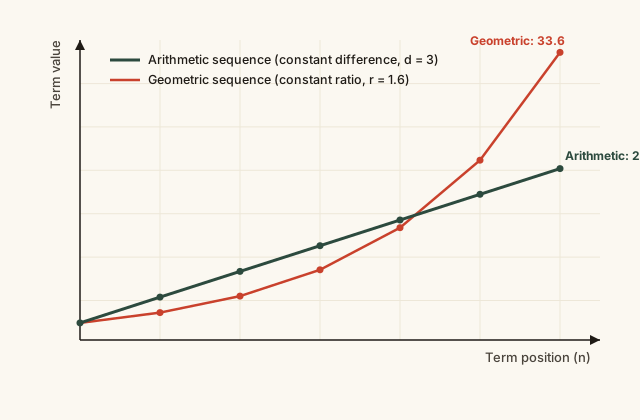
Both sequences can start out looking similar for their first few terms, but the shapes diverge fast: the arithmetic sequence's straight line reflects the same fixed amount being added every step, while the geometric sequence's curve reflects each term being multiplied by the same factor — and multiplication compounds in a way addition never does, which is why the geometric curve eventually rockets past the arithmetic line no matter how large the arithmetic sequence's common difference is.
Common mistakes
Common Mistakes
Mixing up common difference and common ratio, or applying an arithmetic formula to a geometric sequence (or vice versa).
→ Check the sequence first: if consecutive terms have a constant difference, it's arithmetic (use +d). If they have a constant ratio (divide consecutive terms), it's geometric (use ×r).
Off-by-one errors in the nth term formula, such as using n instead of (n - 1) as the exponent or multiplier.
→ Remember the first term a₁ requires zero applications of d or r — plug n = 1 into aₙ = a₁ + (n-1)d and confirm it returns exactly a₁ before trusting the formula for larger n.
Assuming a sequence must keep increasing forever.
→ Sequences can decrease (negative common difference, or a ratio between 0 and 1) or alternate in sign (a negative common ratio) — 'sequence' just means an ordered, rule-based list, with no requirement to grow.
Common misconception
“If a sequence's early terms are increasing, it must be geometric, since geometric sequences 'grow faster.'”
Both arithmetic and geometric sequences can increase, decrease, or stay flat — the type depends entirely on how each term relates to the one before it (addition vs. multiplication), not on whether the sequence happens to be climbing. An arithmetic sequence like 3, 7, 11, 15 grows steadily by adding 4 each time; a geometric sequence like 20, 10, 5, 2.5 shrinks by multiplying by 0.5 each time. The only reliable test is to check whether consecutive terms share a constant difference (arithmetic) or a constant ratio (geometric) — appearance and direction alone can't tell you which type you're looking at.
A sequence is 100, 90, 80, 70, ... — it's decreasing. Does this mean it must be an arithmetic sequence, since geometric sequences only decrease when shrinking toward zero via multiplication?
Try it yourself
What to do next
What to do next
- Take any sequence you notice in real life (savings growing at a fixed deposit per month, a bouncing ball, a discount that repeats) and identify whether it's arithmetic or geometric.
- Use the arithmetic calculator above to find a term far out (like the 100th term) and notice how much faster it is than adding step by step.
- Compare the geometric calculator's output at n = 5 versus n = 10 for the same starting values to see exponential growth accelerate firsthand.
- Read the related entry on Linear Equations Explained to see how an arithmetic sequence's nth term formula is really just a linear equation in disguise.