 KnowThis
Key Takeaways
Key Takeaways
- 1A linear equation is any equation whose graph is a perfectly straight line — no curves, no bends, no breaks.
- 2Written in slope-intercept form y = mx + b, the slope m controls steepness and direction, and the y-intercept b is the starting value where the line crosses the y-axis.
- 3Slope is a rate — it directly represents how fast a real quantity is changing, like dollars per mile or degrees per hour, which is why linear equations show up constantly in pricing, science, and forecasting.
The concept
Slope and y-intercept are abstract until you connect them to something moving or accumulating in the real world — a bill growing with usage, a car eating up distance at a fixed speed, a candle burning down at a steady rate.
A line has the equation y = 4x + 10. What do the 4 and the 10 represent?
Worked examples
Example 1: Calculating slope from two points (baseline case)
Example 2: A negative slope and a zero slope (edge case / variation)
A water tank starts with 500 liters and drains at 25 liters per minute. Which slope value correctly describes this situation as a linear equation?
Example 3: Reading a rideshare pricing line (real-world / applied case)
A rideshare service's fare follows y = 1.75x + 3, where x is miles driven and y is the total fare in dollars. The y-intercept, 3, is the base fee charged even for a near-zero-distance ride. The slope, 1.75, is the per-mile rate — a direct, readable price. For a 10-mile ride: y = 1.75(10) + 3 = 17.50 + 3 = $20.50. Comparing two rideshare services by comparing their slopes (per-mile rates) and y-intercepts (base fees) side by side is exactly how you'd determine which one is cheaper for a long trip versus a short one — the service with the lower slope wins for long distances, regardless of which has the lower base fee.
How it works (visual)
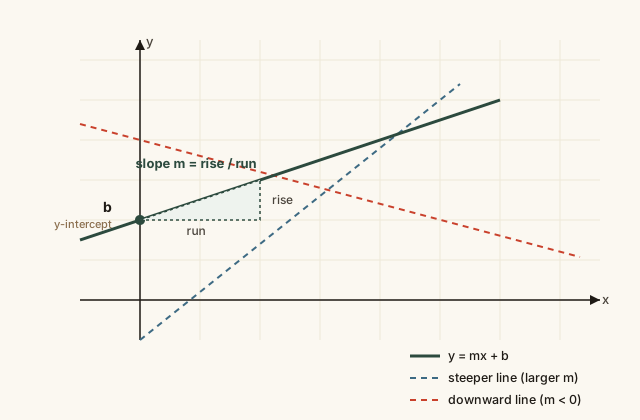
Every straight line on the grid is fully described by just two numbers: where it crosses the y-axis (b) and how steeply it climbs or falls (m). Steeper lines have larger slope magnitudes; lines tilting the opposite direction have negative slopes; and shifting b up or down slides the entire line vertically without changing its angle at all — the visual proof that slope and intercept control genuinely independent things about a line.
Common mistakes
Common Mistakes
Swapping the roles of slope and y-intercept when reading y = mx + b.
→ The number attached to x is always the slope; the standalone number by itself is always the y-intercept. Say it out loud if it helps: 'm for multiplied by x, b for by itself.'
Computing rise over run backwards, e.g. (x₂ - x₁) / (y₂ - y₁) instead of (y₂ - y₁) / (x₂ - x₁).
→ Slope is always change in y (vertical) divided by change in x (horizontal) — y always goes on top. Keep point labels consistent: don't subtract y₂ - y₁ on top while subtracting x₁ - x₂ on the bottom.
Assuming a line with a negative slope isn't 'real' or represents an error.
→ A negative slope simply means the quantity decreases as x increases — a completely normal, common situation (draining tanks, cooling temperatures, depreciating value), not a mistake.
Common misconception
“A steeper-looking line always has a bigger slope number.”
Steepness on a graph is only comparable when both axes use the same scale — the actual slope is a number computed from rise over run, independent of how the graph happens to be drawn. A line with slope 2 plotted on axes where each gridline represents 10 units can look far less steep than a line with slope 0.5 plotted on axes where each gridline represents 1 unit, purely because of the visual scale chosen. Always read the slope from the equation or calculate it from two points — never estimate it by eye from a picture alone, since axis scaling can make any slope look steeper or flatter than it really is.
Two graphs are shown side by side. Graph A's line looks steeper to the eye than Graph B's line. Can you conclude Graph A has the larger slope value?
Try it yourself
What to do next
What to do next
- Find any real pricing plan with a base fee plus a per-unit rate and write it in slope-intercept form (y = mx + b) yourself.
- Use the slope calculator above on two points from the same real line to confirm you get the same slope no matter which two points you pick.
- Practice reading slope's sign correctly: positive means increasing, negative means decreasing, zero means constant.
- Read the related entry on Understanding Inequalities to see how the same slope-intercept idea extends from an exact line to a shaded region.