A language family is a group of languages that descended from a single common ancestral language, proven through systematic sound and grammar correspondences rather than surface resemblance — and the world's languages sort into dozens of these families, from Indo-European to Sino-Tibetan to Niger-Congo to Austronesian.
Reading time
— 5 min
Updated
— Aug 16, 2026
Fact-reviewed
— Aug 16, 2026
Key Takeaways
Key Takeaways
1A language family groups languages by descent from a shared ancestor, proven through regular sound correspondences and core vocabulary — not by how similar two languages happen to sound to a listener.
2Indo-European (English, Hindi, Spanish, Russian, Bengali, and more) is the family with the most total native speakers, but Niger-Congo, spoken across sub-Saharan Africa, contains more individual languages than any other family on Earth.
3Some languages, like Basque and Korean, are isolates or near-isolates — they haven't been convincingly linked to any other known language family at all.
The concept
A language family is a set of languages that all grew out of one shared parent language, the way English, German, and Dutch all descend from a common Germanic ancestor. Linguists group the world's roughly 7,000 living languages (as catalogued by Ethnologue) into dozens of families based on this kind of shared ancestry — Indo-European, Sino-Tibetan, Niger-Congo, Austronesian, Afroasiatic, Dravidian, and many more, each covering languages spread across continents that most speakers would never guess are related.
With that method in mind — regular correspondences, not surface similarity — the world's major families start to make a lot more sense as a family tree rather than a random list.
Quick check
What actually determines whether two languages belong to the same language family?
Worked examples
Example 1: Indo-European — the family with the most total native speakers (baseline case)
Indo-European covers roughly 40% of the world's population as a first language, spanning branches most people wouldn't immediately connect: Germanic (English, German, Dutch, Swedish), Romance (Spanish, French, Portuguese, Italian, Romanian — all descended from Latin), Slavic (Russian, Polish, Ukrainian), Indo-Aryan (Hindi, Bengali, Punjabi, Urdu), and Iranian (Persian, Pashto), among others. English and Hindi look and sound almost nothing alike today, but both trace back through this same family tree to Proto-Indo-European, spoken an estimated 4,000-6,000 years ago somewhere in the Pontic-Caspian steppe region, according to the leading scholarly reconstruction.
Example 2: Niger-Congo and Austronesian — the families defined by sheer number of languages, not population share (variation)
Niger-Congo, spoken across most of sub-Saharan Africa, includes Swahili, Yoruba, Igbo, Zulu, and Shona among well over a thousand distinct languages — more individual languages than any other family, even though its total speaker population is smaller than Indo-European's. Austronesian tells an even more striking geographic story: it stretches from Madagascar off the coast of East Africa, across Indonesia, the Philippines, and Malaysia, to the Pacific islands and all the way to Hawaii and Easter Island — the most geographically widespread family on Earth prior to European colonial expansion, connecting Malagasy, Tagalog, Malay/Indonesian, and Hawaiian as genuine linguistic relatives despite thousands of miles of open ocean between their speaker communities.
Example 3: Dravidian and Sino-Tibetan — major families that predate or sit entirely outside Indo-European (real-world / applied case)
Dravidian languages — Tamil, Telugu, Kannada, and Malayalam, spoken mainly in southern India and Sri Lanka — are unrelated to the Indo-Aryan languages of northern India; Tamil in particular has a documented literary tradition stretching back over two thousand years, independent of Sanskrit-derived vocabulary. Sino-Tibetan, meanwhile, is the family behind Mandarin and Cantonese Chinese, Tibetan, and Burmese, and by number of native speakers is second only to Indo-European worldwide. Recognizing these families matters practically: someone fluent in Hindi gets little grammatical head start learning Tamil, and Mandarin's tonal, isolating grammar has essentially nothing in common structurally with the Indo-European languages a learner might already know.
Quick check
Which family is the most geographically widespread, stretching from Madagascar to Hawaii and Easter Island?
How it works (visual)
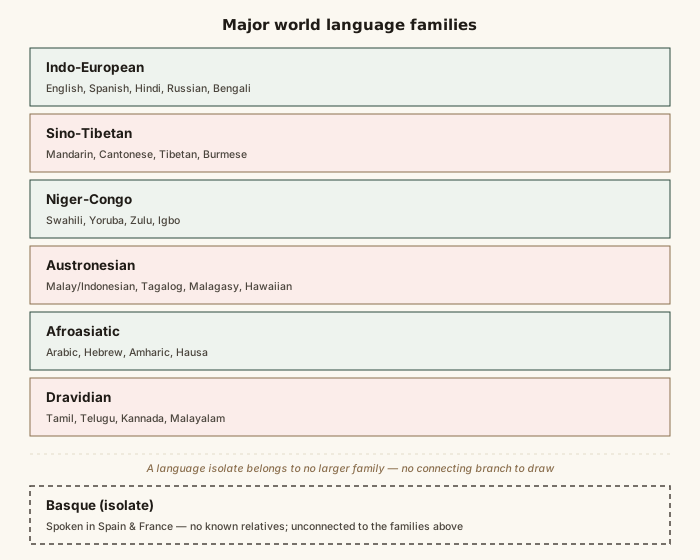
Major world language families and example member languages
Notice how each branch fans out into member languages that can look and sound completely different from each other on the surface — that's expected after thousands of years of separate change, and it's exactly why the comparative method, not surface resemblance, is what confirms the underlying relationship.
Common mistakes
Common Mistakes
✕
Assuming two languages are related just because they sound similar or share a few words.
→ Check for systematic sound correspondences across core vocabulary — a handful of similar words is more often coincidence or borrowing than genuine shared ancestry.
✕
Treating 'language family' and 'geographic region' as the same thing.
→ Family membership is about descent, not location — Hungarian (Uralic) sits inside Indo-European-speaking Europe, and Malagasy (Austronesian) sits off the coast of Africa, both unrelated to their geographic neighbors.
✕
Assuming every language belongs to some larger family.
→ A small number of languages, like Basque and (by most classifications) Korean, are isolates with no confirmed relatives — that's a legitimate, established linguistic category, not a gap in research.
Common misconception
“Languages that sound alike, or share some vocabulary, must be closely related.”
Similarity can come from three very different sources — genuine shared ancestry, borrowing between neighboring languages, or pure coincidence — and only the first one defines a language family. English borrowed enormous amounts of vocabulary from French and Latin, but English is Germanic, not Romance; the borrowed words don't change its family membership. Meanwhile, Japanese and Korean have structural similarities (word order, some grammar patterns) that led to a long-debated hypothesis linking them, but mainstream historical linguistics has not confirmed a shared-ancestry relationship between them — similarity alone isn't proof.
Quick check
English borrowed a huge share of its vocabulary from French and Latin after the Norman Conquest. Does this make English a Romance language?
What to do next
What to do next
Next time you hear two languages described as 'similar,' ask whether that's shared ancestry, historical borrowing, or coincidence — they're very different claims.
When learning a new language, check its family first — a language from a familiar family (like Spanish for an English speaker) shares more grammatical shortcuts than one from an unrelated family (like Mandarin or Tamil).
Look up which family your own first language belongs to and skim its other members — you'll likely recognize more cognates than expected.
Read the entry on how languages evolve over time to see the actual mechanisms (sound change, borrowing, drift) that split one ancestral language into an entire family.
FAQ
FAQ
Related terms
Related terms
Language family
A group of languages that share a common ancestral language (a 'proto-language'), established through systematic, regular sound and grammar correspondences rather than surface similarity.
Proto-language
A reconstructed ancestral language, not directly attested in any surviving text, inferred by comparing its descendant languages — e.g. Proto-Indo-European, the reconstructed ancestor of English, Hindi, Russian, and hundreds of other languages.
Language isolate
A language with no known relatives — it cannot be grouped into any established family. Basque, spoken in parts of Spain and France, is the best-known example in Europe.
Comparative method
The linguistic technique of systematically comparing related languages' sound patterns and core vocabulary to reconstruct their shared ancestor and confirm they're genuinely related, rather than just borrowing words from each other.
 KnowThis