A language is endangered when it stops being reliably passed to children as a first language, regardless of how many older speakers still use it fluently — and while most endangered languages are lost within a generation or two without intervention, deliberate revitalization has brought a small number back from the brink.
Reading time
— 5 min
Updated
— Aug 16, 2026
Fact-reviewed
— Aug 16, 2026
Key Takeaways
Key Takeaways
1A language is considered endangered when it stops being reliably passed to children as a first language — not simply when it has a small number of speakers.
2UNESCO tracks language vitality on a six-level scale, from 'safe' to 'extinct,' and estimates that a large share of the world's roughly 7,000 languages fall somewhere on the endangered end of that scale.
3Endangerment is usually driven by identifiable external pressures — historical policies restricting a language in schools, economic incentives to shift to a dominant language, and displacement — not by speakers simply losing interest.
The concept
A language is endangered when children in its community are no longer growing up learning it as their first language — even if plenty of older adults still speak it fluently. A language is extinct once no one uses it as a living, everyday means of communication anymore, usually marked by the death of the last fully fluent speaker. Between "perfectly safe" and "extinct" sits a wide range of endangerment levels, depending on how consistently the language is still being taught to the next generation.
With intergenerational transmission as the real measure of vitality, and dormancy as a distinct category from total loss, the actual scale of the world's endangered-language situation — and the handful of documented exceptions — comes into clearer focus.
Quick check
A language has around 3,000 fluent speakers, all of them over the age of 60, and no children currently learning it at home. By linguists' usual standard, is this language endangered?
Worked examples
Example 1: Applying UNESCO's vitality scale to a currently endangered language (baseline case)
UNESCO's framework runs from "safe" through "vulnerable," "definitely endangered," "severely endangered," and "critically endangered," to "extinct." Ainu, indigenous to northern Japan and parts of Russia's Sakhalin and Kuril Islands, is documented as critically endangered — the language has extremely few remaining fluent speakers, nearly all elderly, with intergenerational transmission having broken down over the course of the 20th century amid assimilation policy and social pressure to shift to Japanese. Community and academic documentation and revitalization efforts continue, but the language sits at the most severe end of the scale short of extinction.
Example 2: Cornish — a documented revival after extinction (variation / exception)
Cornish is one of the clearest documented cases of a language crossing all the way to extinction as a spoken community language and then being revived. After its decline as an everyday spoken language by the late 18th century, 20th-century revivalists worked from surviving historical texts, records, and place names to reconstruct its grammar and vocabulary, and began teaching it again. Cornish today has a small but active community of speakers and learners, and is recognized under the UK's commitments to the European Charter for Regional or Minority Languages — a genuine exception to the general rule that language loss is permanent, though revival efforts of this kind are difficult, resource-intensive, and rare.
Example 3: Hebrew and modern revitalization methods (real-world / applied case)
Hebrew is the most frequently cited large-scale revitalization success: for centuries it survived mainly as a liturgical and literary language, not as anyone's everyday spoken first language, before a deliberate movement beginning in the late 19th and early 20th centuries revived it as a spoken vernacular, and it is now the first language of millions of people in Israel. That scale of revival is rare, but its methods — deliberate immersion, dedicated schooling, and institutional adoption — inform smaller-scale revitalization work happening today, including Māori-language "language nest" immersion preschools in New Zealand and Hawaiian-language immersion schools in the United States, both aimed at rebuilding intergenerational transmission where it had been broken.
Quick check
What made Hebrew's revival unusual compared to most language revitalization efforts?
How it works (visual)
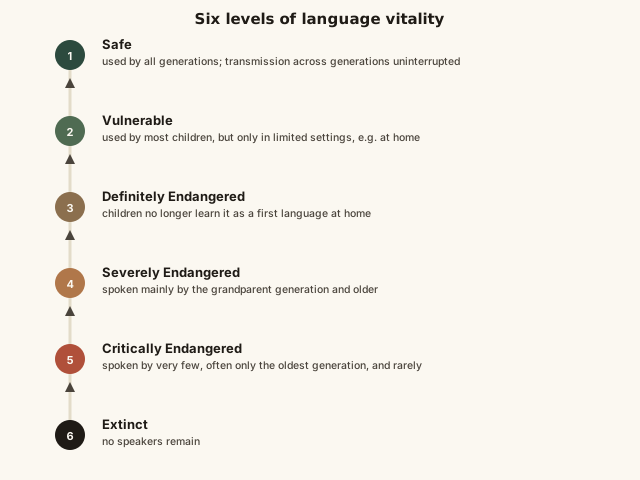
UNESCO's six-level language vitality scale
The scale makes clear that endangerment is a gradual slide rather than a sudden event — and that the critical turning point, at "definitely endangered," is specifically about whether children are still learning the language, not about total speaker numbers.
Common mistakes
Common Mistakes
✕
Equating a small number of speakers with automatic endangerment.
→ Check whether children are still learning the language as a first language — a small community with active child transmission can be more stable than a larger, aging-only one.
✕
Assuming an extinct language can never be revived.
→ A small number of languages, including Cornish and Hebrew, have been revived from documentation and deliberate teaching, though it is difficult, slow, and far from guaranteed.
✕
Treating language endangerment as a natural, inevitable process unconnected to history or policy.
→ Documented drivers include historical policies restricting a language in schools, forced assimilation programs, and economic pressure to shift to a dominant language for employment — not a neutral or inevitable drift.
Common misconception
“A language 'dying out' means its speakers simply stopped caring about it.”
Language shift is usually driven by identifiable external pressures rather than indifference. Historically documented drivers include government and colonial-era policies that banned or penalized use of a language in schools, forced-assimilation boarding school systems, and strong economic incentive to raise children in a dominant language associated with jobs, education, and social mobility. Families frequently make this shift specifically because they believe it will benefit their children's opportunities — not because they've stopped valuing their own language. UNESCO and linguists documenting language endangerment consistently point to these structural pressures as the primary drivers, not a simple loss of community interest.
Quick check
A community shifts from raising children in its traditional language to raising them in a dominant national language, largely because the national language is required for schooling and jobs. What does this best illustrate?
What to do next
What to do next
Look up whether any Indigenous or minority languages are spoken in your own region, and check their documented vitality status.
Notice when something described as 'just a dialect' might actually be a distinct, separately endangered language.
If you're curious about a lesser-spoken language, seek out learning resources or media in it — documented use is part of what sustains a language.
Read the entry on language families to see how much of the world's language diversity concentrates in a small number of large families versus thousands of smaller, more vulnerable ones.
FAQ
FAQ
Related terms
Related terms
Language endangerment
A state in which a language is at risk of falling out of use because it is no longer being reliably learned by children as a first language, regardless of how many fluent adult or elderly speakers remain.
Language death / extinction
The point at which a language has no remaining speakers who use it as a living, everyday means of communication — typically marked by the death of the last fully fluent speaker, though the language may survive in documentation.
Intergenerational transmission
The passing of a language from one generation to the next as a first language — considered by linguists to be the single most important factor in whether a language is stable or endangered, more important than raw speaker count.
Language revitalization
Deliberate efforts to increase the number of speakers of an endangered or extinct language, or restore its use as a living first language, through methods like immersion schools, documentation, and community programs.
Dormant (sleeping) language
A language with no remaining fluent native speakers but with surviving documentation, records, or partial community knowledge that can support later revitalization efforts, distinct from a language lost with no trace.
 KnowThis