 KnowThis
Key Takeaways
Key Takeaways
- 1Before unification, "Germany" and "Italy" were geographic and cultural terms, not countries — the German lands held dozens of separate kingdoms and free cities, and the Italian peninsula was divided among kingdoms, the Papal States, and Austrian-controlled territories.
- 2Both unifications were driven substantially by war, not peaceful federation: Prussia under Otto von Bismarck fought three deliberate wars (against Denmark, Austria, and France) between 1864 and 1871, while Italian unification combined Piedmont-Sardinia's diplomacy with Giuseppe Garibaldi's volunteer military conquest of southern Italy.
- 3Both new nation-states were proclaimed within months of each other — Italy's kingdom in 1861 (completed with Rome's annexation in 1870-71) and the German Empire in January 1871 — reshaping the European balance of power heading into the 20th century.
The concept
That detail — a German empire proclaimed inside a French palace, at France's expense — is a useful reminder that unification wasn't a tidy, celebratory process for everyone involved; it created new resentments even as it resolved old fragmentation.
Which best describes the state of the German lands before unification?
Worked examples
Cavour's diplomacy and the war against Austria, 1859 (baseline case)
Garibaldi and the Thousand, 1860 (variation / grassroots case)
Bismarck's Franco-Prussian War and the birth of the German Empire, 1870-71 (real-world / applied case)
How did Giuseppe Garibaldi's role in Italian unification differ from Camillo di Cavour's?
How it works (visual)
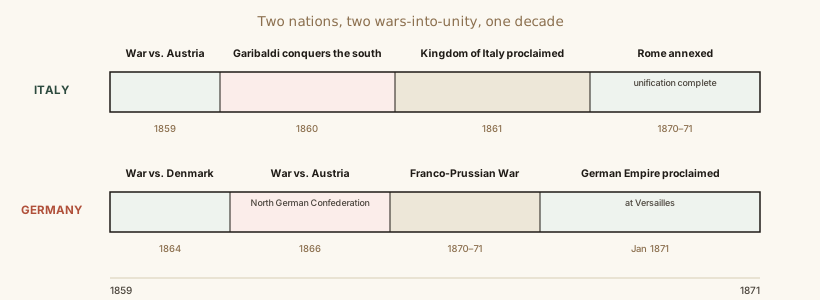
Laid side by side, the two timelines converge almost exactly in 1870-71 — Italy completing unification with Rome and Germany completing it with the Empire's proclamation, both within the same narrow window, and both closely tied to the same event: France's defeat in the Franco-Prussian War, which simultaneously let Italian troops take Rome (as French protection withdrew) and let Bismarck proclaim his new Empire on French soil.
Common mistakes
Common Mistakes
Assuming Germany and Italy have existed as unified nations since ancient or medieval times.
→ Both are relatively young nation-states — Italy unified in 1861-71 and Germany in 1871, both after centuries of political fragmentation into separate kingdoms and states.
Treating unification as a single peaceful vote or treaty rather than a series of wars and calculated political maneuvers.
→ Both processes involved real armed conflict — Prussia fought three separate wars between 1864 and 1871, and Italian unification included the 1859 war with Austria and Garibaldi's armed conquest of the south.
Confusing the Holy Roman Empire (dissolved in 1806) with the German Empire founded in 1871.
→ These are different entities separated by over 60 years — the Holy Roman Empire was a loose medieval confederation, while the German Empire was a modern, centralized nation-state under Prussian leadership.
Common misconception
“German and Italian unification happened through a single, clean process rather than complex, often military, phases.”
Both unifications unfolded in stages over roughly a decade, each involving real war, diplomacy, and compromise rather than one clean founding moment. Italy took from 1859 to 1871 to reach its final borders (Rome was the last major piece, added in 1870-71), and Germany's unification required three separate wars — against Denmark, Austria, and France — fought over seven years by Prussia under Bismarck before the Empire could be proclaimed in 1871. Neither country's modern borders or government structure emerged fully formed from a single event.
How long did it take Italy to unify, from the first major war to the final territorial addition?
What to do next
What to do next
- Next time you hear "Germany" or "Italy" referenced in a pre-1861 historical context, mentally check that the source is likely talking about a region or culture, not a unified nation.
- Notice how often 19th-century nation-building involved deliberate war rather than peaceful federation — Bismarck's Realpolitik is a useful lens for looking at other unification and independence movements.
- When you visit or read about the Hall of Mirrors at Versailles, remember it hosted both the 1871 proclamation of the German Empire and, decades later, the 1919 treaty that ended World War I.
- Read the related entry on World War I to see how the newly unified, ambitious Germany fits into the tensions that led to war just decades after 1871.