The "age of empires" refers to the 19th century, when industrialized nations — chiefly Britain, France, Russia, and later Germany, the United States, and Japan — expanded colonial and imperial control over most of Africa, Asia, and the Pacific, driven by industrial technology, competition for resources, and nationalist ambition.
Reading time
— 5 min
Updated
— Aug 16, 2026
Fact-reviewed
— Aug 16, 2026
Key Takeaways
Key Takeaways
1By 1900, European powers alone controlled roughly 84% of the world's land surface through colonies, protectorates, or spheres of influence — up sharply from earlier centuries because industrial technology (steamships, railways, repeating rifles, quinine to treat malaria) made deep territorial conquest newly practical.
2The "Scramble for Africa" (roughly 1881-1914) saw the continent divided almost entirely among European powers in about three decades, formalized at the 1884-85 Berlin Conference, where no African leaders were present or consulted.
3Imperial expansion wasn't only European — the United States (Philippines, Puerto Rico, Hawaii) and Japan (Taiwan, Korea) built their own overseas empires in this same period, using comparable industrial and military advantages.
The concept
The 19th century is often called an "age of empires" because a small number of industrialized nations — mainly Britain, France, Russia, and later Germany — expanded their control over huge parts of Africa, Asia, and the Pacific. This wasn't simply trade or influence; it usually meant direct political rule, extraction of resources like rubber, cotton, and minerals, and the imposition of colonial administrations over existing societies and kingdoms. By the century's end, Britain alone governed roughly a quarter of the world's population through its empire, and similar (if smaller) patterns played out for France, Belgium, Germany, Portugal, and others.
That gap between the neat lines drawn in a European conference room and the complicated societies those lines cut across is central to understanding why 19th-century imperial borders still matter today.
Quick check
What was the Berlin Conference (1884-85)?
Worked examples
The British Raj in India (baseline case)
Britain's rule in India shifted in 1858 from the private East India Company to direct Crown control (the "British Raj"), following the 1857 rebellion. India became the "jewel" of the British Empire — a major source of raw cotton, tea, and later a large market for British manufactured goods — and Queen Victoria was declared Empress of India in 1877. British colonial administration built railways and telegraph networks (largely to serve extraction and troop movement) while restricting Indian self-governance and imposing British legal and educational systems.
King Leopold II's Congo Free State (variation / extreme case)
Unlike most African territory, the Congo Free State (1885-1908) wasn't a colony of a nation but the personal property of Belgium's King Leopold II, acquired at the Berlin Conference under the guise of humanitarian and "free trade" aims. In practice, forced labor extracting rubber under a brutal quota system caused millions of deaths through violence, disease, and starvation. International outrage — documented by journalists, missionaries, and figures like Edmund Dene Morel and Roger Casement — eventually forced the Belgian government to take over the territory directly in 1908, ending Leopold's personal rule but not Belgian colonial control itself.
The United States and Japan as non-European empire builders (real-world / applied case)
Imperial expansion in this era wasn't limited to Europe. Following the Spanish-American War (1898), the United States took control of the Philippines, Puerto Rico, and Guam, and separately annexed Hawaii — extending U.S. political and military reach well beyond the continental mainland. Japan, having rapidly industrialized after the 1868 Meiji Restoration, defeated China (1894-95) and Russia (1904-05) in quick succession and colonized Taiwan and later Korea (formally annexed in 1910), demonstrating that industrial-era imperialism was a strategy available to any nation with the technological and military base to pursue it, not a uniquely European phenomenon.
Quick check
Was 19th-century imperial expansion limited to European powers?
How it works (visual)
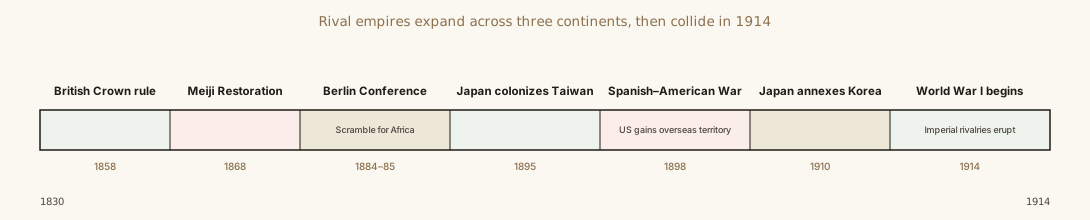
Timeline: the 19th-century age of empires, 1830-1914
The timeline matters because it shows imperial competition accelerating right up until 1914 — the same rivalries, alliances, and nationalist pressures that built these empires are widely cited by historians as part of the tangled background tension that helped make World War I possible.
Common mistakes
Common Mistakes
✕
Assuming 19th-century imperialism was an exclusively European phenomenon.
→ The United States and Japan both built substantial overseas empires in the same period, using the same industrial and military advantages as European powers.
✕
Treating the Scramble for Africa as a single, coordinated colonial project rather than competitive land-grabbing among rival powers.
→ European powers were often racing each other for territory, sometimes nearly going to war with one another over competing claims — cooperation (like at the Berlin Conference) was about managing that rivalry, not eliminating it.
✕
Assuming colonial borders reflected existing African political, ethnic, or linguistic boundaries.
→ Most borders were drawn in European negotiations with little regard for existing societies, frequently splitting single ethnic groups across multiple colonies or combining rival groups within one — a legacy still visible on the modern map.
Common misconception
“European colonization of Africa was a centuries-long, gradual process similar to earlier colonization elsewhere in the world.”
Most of Africa's interior was colonized extremely rapidly by historical standards — roughly 1881 to 1914, often called the "Scramble for Africa." In 1870, European powers controlled about 10% of the African continent, mostly coastal trading posts; by 1914, that figure had risen to roughly 90%, with only Ethiopia and Liberia remaining independent. The speed was a direct product of new industrial-era technology (steamships, repeating rifles, quinine, telegraphs) rather than a slow multi-century expansion.
Quick check
How quickly did European powers colonize the African continent?
What to do next
What to do next
Next time you look at a map of modern African national borders, notice how many are straight lines — a strong sign the border was drawn by treaty rather than following any natural or cultural boundary.
When you hear "the age of imperialism" described as purely a European story, mentally add the U.S. and Japan as parallel, non-European examples of the same pattern.
Notice when a historical event (like the Berlin Conference) is described as a diplomatic or humanitarian achievement — check whose interests were actually represented in the room.
Read the related entries on Colonialism and World War I to see how this period's rivalries connect directly to the war that followed.
FAQ
FAQ
Related terms
Related terms
Imperialism
The policy of a nation extending its power over other territories, typically through conquest, settlement, or economic domination.
Scramble for Africa
The rapid colonization of nearly the entire African continent by European powers between roughly 1881 and 1914.
Berlin Conference
An 1884-85 meeting of European powers in Berlin that set rules for dividing Africa into colonial territories, with no African representatives present.
Sphere of influence
A region where one foreign power claims exclusive trading or political rights, without necessarily governing it outright as a colony.
 KnowThis