The Middle Ages (roughly 500-1500 CE) was the period of European history between the fall of the Western Roman Empire and the start of the Renaissance, marked by feudal political organization, the influence of the Church, and — despite the old "Dark Ages" label — significant technological and institutional development.
Reading time
— 4 min
Updated
— Aug 17, 2026
Fact-reviewed
— Aug 17, 2026
Key Takeaways
Key Takeaways
1The Middle Ages ran roughly from the fall of the Western Roman Empire (476 CE) to the start of the Renaissance (around 1400-1500 CE) — about a thousand years, not a brief gap between "real" eras.
2"Dark Ages" was a label coined by later Renaissance scholars to flatter their own era by contrast — historians today generally avoid it because it badly undersells medieval technological, legal, and institutional achievement.
3Feudalism, the system of land-for-loyalty exchanges structuring medieval society, developed gradually and unevenly across Europe — it was never one single uniform rulebook applied everywhere at once.
The concept
The Middle Ages, also called the medieval period, covers roughly a thousand years of European history between the collapse of the Western Roman Empire in 476 CE and the start of the Renaissance around 1400-1500 CE. Without a central Roman government, power in Europe became local and personal — land-owning lords protected the people who worked their land, in exchange for labor, loyalty, and military service, a system historians call feudalism. The Christian Church became one of the most powerful and unifying institutions across a politically fragmented continent.
That "Dark Ages" framing is worth examining directly, because it shapes how most people picture this period before looking at any specific evidence from it.
Quick check
Why do most historians today avoid using the term "Dark Ages" for the medieval period?
Case studies
Case 1: The manor and feudal daily life (baseline case)
Under manorialism, most medieval Europeans were peasants who worked land belonging to a lord, giving a share of their harvest and labor in exchange for protection and the right to farm a portion for themselves. Above the peasants, knights and lesser lords held land (fiefs) from greater lords in exchange for military service, forming a layered chain of obligation running up to kings — though in practice, royal power was often much weaker on the ground than the org chart suggests, with local lords holding real day-to-day authority.
Case 2: Medieval technology that's often overlooked (variation / evidence against "Dark Ages")
The heavy plow, horse collar, and three-field crop rotation system, all adopted widely during the medieval period, significantly increased European agricultural output — historians estimate medieval agricultural innovation contributed to real population growth during the High Middle Ages. Mechanical clocks appeared in European monasteries and towns by the late 13th century, eyeglasses were invented in Italy around 1286, and Gothic cathedrals like Chartres and Notre-Dame de Paris required genuinely advanced structural engineering (flying buttresses, ribbed vaulting) to build safely at their scale.
Case 3: Medieval universities and the roots of modern higher education (real-world / applied case)
The University of Bologna (founded 1088), the University of Paris (c. 1150), and the University of Oxford (teaching from at least 1096) established the model — degrees, structured curricula, faculties, academic freedom debates — that modern universities still broadly follow. Scholasticism, the dominant medieval method of study, combined Christian theology with the logical rigor of rediscovered Aristotelian philosophy (much of it transmitted to Western Europe via Islamic scholars, see Islamic Golden Age), producing thinkers like Thomas Aquinas whose work is still studied in philosophy departments today.
Quick check
Which of these is a real medieval innovation, not a Renaissance or later invention?
How it works (visual)
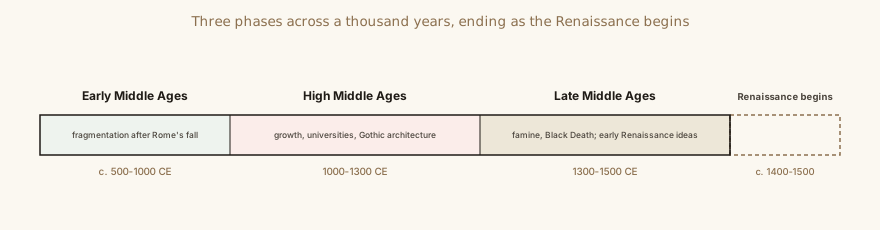
The three phases of the European Middle Ages, c. 500-1500 CE
The key thing to notice: the "crisis" phase most people associate with a grim medieval stereotype — famine, plague, war — is really concentrated in the Late Middle Ages, the last two of the period's roughly ten centuries, not the whole era.
Common mistakes
Common Mistakes
✕
Assuming the entire Middle Ages was a single grim, static, unchanging period.
→ Treat it as three distinct phases across roughly a thousand years, with real growth and innovation especially in the High Middle Ages (1000-1300 CE), not one flat "dark" stretch.
✕
Assuming feudalism was one uniform, formally codified system applied identically everywhere in Europe.
→ It developed unevenly by region and over time, and historians increasingly debate how uniformly "feudalism" as a single system actually applied — treat it as a useful general description, not a rigid rulebook.
✕
Thinking medieval people believed the Earth was flat.
→ Educated medieval Europeans, following ancient Greek astronomy which was well preserved and taught, generally understood the Earth was spherical — the flat-Earth myth about medieval belief was largely a later 19th-century fabrication.
Common misconception
“People in medieval Europe believed the Earth was flat.”
Educated medieval Europeans, including scholars at the universities discussed above, generally accepted the Earth was spherical, a fact inherited from ancient Greek astronomy (Eratosthenes had even calculated the Earth's circumference with reasonable accuracy around 240 BCE) and taught in medieval schools. The popular myth that Columbus had to convince people the Earth wasn't flat largely traces to a fictionalized 19th-century biography of Columbus, not to any real medieval belief.
What to do next
What to do next
Next time you hear "Dark Ages," mentally swap in "Early Middle Ages" and remember the label was coined by people flattering their own era, not a neutral description.
If someone repeats the medieval-flat-Earth myth, you now know it traces to a 19th-century fictionalized biography, not real medieval belief.
Notice how many things trace to the High Middle Ages next time you encounter them — universities, eyeglasses, mechanical clocks, Gothic cathedrals.
FAQ
FAQ
Related terms
Related terms
Feudalism
A medieval European system where land was exchanged for military service and loyalty, structuring society into lords, vassals, and peasants.
Fief
Land granted by a lord to a vassal in exchange for military service and loyalty under the feudal system.
Manorialism
The medieval economic system organizing peasant labor around a lord's estate (manor), where peasants worked land in exchange for protection and a share of produce.
Scholasticism
A medieval method of critical thought taught in universities, combining Christian theology with classical logic, especially from Aristotle.
 KnowThis