Ancient Rome grew from a small city-state around 753 BCE into a Republic (509 BCE–27 BCE) and then an Empire that at its height controlled territory from Britain to Egypt, leaving a lasting mark on law, language, architecture, and government still visible today.
Reading time
— 5 min
Updated
— Aug 16, 2026
Fact-reviewed
— Aug 16, 2026
Key Takeaways
Key Takeaways
1Rome was a Republic — governed by elected officials, not a king — for almost 500 years (509-27 BCE) before becoming an Empire ruled by a single emperor.
2The switch from Republic to Empire wasn't a foreign conquest — it grew out of the Republic's own internal political breakdown, civil wars, and the rise of powerful individual generals like Julius Caesar.
3At its height under the Pax Romana (27 BCE-180 CE), Rome controlled roughly 5 million square kilometers, stretching from Britain to Egypt to the Persian Gulf.
The concept
Rome began as a small city in central Italy, traditionally founded in 753 BCE, and eventually grew to control an empire spanning three continents. For most of its early history, Rome wasn't ruled by an emperor — it was a Republic, governed by elected officials and a Senate of influential citizens, with power deliberately spread out to prevent any one person from becoming a king again (Rome's founding myth includes throwing out its last king in 509 BCE). That system lasted almost 500 years before breaking down into civil war and, eventually, one-man rule under an emperor.
That collapse from Republic to Empire is Rome's central political story — but it's worth separating from the other reason Rome still matters: what actually got built, governed, and passed down during the roughly thousand years the Roman state, in one form or another, controlled the Mediterranean world.
Quick check
What caused the Roman Republic to become the Roman Empire?
Case studies
Case 1: Roman roads and engineering (baseline case)
At its peak, the Roman road network covered an estimated 400,000 kilometers, built with multiple layers of graded stone and drainage that let many sections survive intact for over two thousand years — parts of the Appian Way, begun in 312 BCE, are still walkable today. Roman concrete, using volcanic ash, proved so durable that structures like the Pantheon's dome (completed around 128 CE) remain the largest unreinforced concrete dome in the world, and modern researchers have studied Roman concrete specifically because some formulations appear to have gotten stronger, not weaker, from prolonged seawater exposure.
Case 2: Roman law and governance across a diverse empire (variation / exception)
Rome governed an enormously diverse population — Egyptians, Greeks, Gauls, Britons, and many others — not by imposing uniform culture everywhere, but through a flexible system of citizenship, local self-governance under Roman oversight, and a body of law (eventually codified centuries later in the Byzantine Emperor Justinian's Corpus Juris Civilis, 529–534 CE) that became the foundation for legal systems across much of continental Europe and Latin America today, known as civil law. Roman citizenship itself expanded gradually — the Edict of Caracalla in 212 CE extended citizenship to nearly all free inhabitants of the Empire, a striking example of a Roman institution deliberately broadening rather than narrowing over time.
Case 3: Latin's afterlife in modern language and government (real-world / applied case)
Latin, Rome's language, evolved directly into the Romance languages — Spanish, French, Italian, Portuguese, and Romanian — and supplied roughly 60% of English vocabulary, mostly through French after the Norman Conquest and through direct scholarly borrowing. Terms like "senate," "republic," "committee," and "veto" (Latin for "I forbid") come straight from Roman political vocabulary, and the basic idea of a republic with elected representatives and a written constitution, revived explicitly by Renaissance and Enlightenment thinkers who studied Roman history, directly shaped the design of modern governments, including the framers of the U.S. Constitution.
Quick check
Why is Roman concrete of particular interest to modern engineers?
How it works (visual)
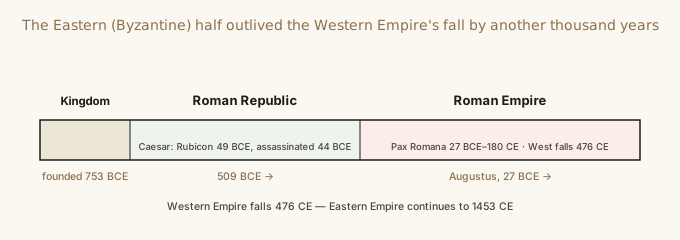
Rome: from city-state to Republic to Empire, 753 BCE - 476 CE
Notice the Republic (roughly 480 years) actually lasted longer than the Western Empire that followed it (roughly 500 years, but with serious decline setting in from the 3rd century CE onward) — Rome's "republic" phase isn't a short prelude to "the real Rome," it's a comparably long and formative era in its own right.
Common mistakes
Common Mistakes
✕
Assuming "ancient Rome" always means the Empire with emperors like Julius Caesar or Augustus.
→ Julius Caesar was never actually an emperor — he was a dictator under the Republic, assassinated before the Empire began. Augustus, his heir, was the first true emperor, starting in 27 BCE.
✕
Thinking the Roman Empire ended in 476 CE for the whole Roman world.
→ 476 CE marks the fall of the WESTERN Roman Empire only — the Eastern Roman Empire, known as the Byzantine Empire, continued for almost another thousand years, until 1453 CE.
✕
Picturing Roman gladiatorial games and emperors as representative of daily Roman life.
→ Most Romans were farmers, laborers, or tradespeople whose daily lives centered on work, family, and local religious practice — the spectacle of the Colosseum was real but not typical of ordinary experience.
Common misconception
“Julius Caesar was a Roman emperor.”
Julius Caesar was never emperor — he held the Republican title of dictator (a legal, temporary emergency office that he extended to hold indefinitely), and was assassinated in 44 BCE, 17 years before the Roman Empire technically began. His adopted heir Octavian, later called Augustus, became Rome's actual first emperor in 27 BCE. Caesar's career is central to why the Republic collapsed, but he died before the Empire he helped make possible actually existed.
What to do next
What to do next
Next time "Julius Caesar, Roman Emperor" comes up, you'll know to correct it — he was a Republican dictator, never emperor.
Notice how many English legal and political words — senate, committee, veto, republic — are unmodified or lightly modified Latin.
If you visit or see photos of a Roman aqueduct or road, remember it may genuinely be original construction, not a modern reconstruction — Roman engineering was built to last, and often did.
FAQ
FAQ
Related terms
Related terms
Roman Republic
The period (509-27 BCE) when Rome was governed by elected officials and the Senate rather than a king or emperor.
Roman Empire
The period (27 BCE onward) when Rome was ruled by a single emperor, beginning with Augustus.
Senate
The council of Rome's most powerful and experienced citizens, which advised on and heavily influenced policy throughout both the Republic and Empire.
Pax Romana
Latin for "Roman Peace" — the roughly 200-year period (27 BCE-180 CE) of relative stability and prosperity across the Roman Empire.
 KnowThis