Many widely repeated "facts" about history — from horned Viking helmets to Napoleon's height to Marie Antoinette's most famous supposed quote — are documented myths, often traceable to a specific later source rather than the historical period they claim to describe.
Reading time
— 5 min
Updated
— Aug 16, 2026
Fact-reviewed
— Aug 16, 2026
Key Takeaways
Key Takeaways
1Many popular "historical facts" are documented myths — the horned Viking helmet, for instance, has no archaeological basis and traces to 19th-century opera costume design, not the Viking Age itself.
2Some myths, like Napoleon's supposed short height, come from a real but misunderstood detail (a difference between French and English units of measurement at the time), not pure invention.
3The most reliable way to check a historical claim is to ask who first said or wrote it, and when — many myths turn out to date from decades or centuries after the events they claim to describe.
The concept
A lot of what people confidently repeat about history turns out not to be true, or not to be as simple as the popular version suggests. These historical myths spread because they're memorable, visually striking, or make a good story — a horned helmet, a callous royal quote, an emperor mocked for being short. The trouble is that historians, checking these claims against the actual evidence from the time, often find no support for them at all, or find that the popular version has quietly swapped out an inconvenient detail for a more dramatic one.
With that pattern in mind — a myth's popular version is often much newer than the history it claims to describe — the specific examples below make a lot more sense once you see where each one actually came from.
Quick check
What is a reliable first step historians use to test whether a popular historical claim is actually true?
Worked examples
Example 1: "Let them eat cake" — a quote Marie Antoinette almost certainly never said (baseline case)
The phrase, famously attributed to Marie Antoinette as a callous response to hearing that French peasants had no bread, has no reliable documentation connecting her to it. The earliest known version of the line ("Qu'ils mangent de la brioche," roughly "let them eat brioche") appears in philosopher Jean-Jacques Rousseau's autobiography, Confessions, written in the 1760s and published in 1782 — attributed there to an unnamed "great princess," years before Marie Antoinette, who married into the French royal family in 1770, was in any position of public visibility in France. Historians generally treat the attribution to her as a later legend, likely attached to her because she was already unpopular and became a convenient symbol during and after the French Revolution.
Example 2: Napoleon's "short" height — a real measurement detail, exaggerated (variation / myth with a kernel of truth)
Unlike a pure fabrication, this myth grew from a real but misunderstood detail. At his death, Napoleon's height was recorded as 5 feet 2 inches — in French units of the time, where the French inch (pouce) was slightly longer than the English inch. Converted properly, that comes out to roughly 5 feet 7 inches (about 170 cm) in modern measurement, close to or slightly above the average height for a Frenchman of his era. The "short Napoleon" caricature was also actively reinforced by British political cartoonists, notably James Gillray, whose satirical depictions of a diminutive Napoleon were more about mockery than measurement.
Example 3: The medieval "flat Earth" myth and why it still matters today (real-world / applied case)
Educated people in medieval Europe did not generally believe the Earth was flat — the spherical Earth model, established by ancient Greek astronomers, remained the standard scholarly understanding throughout the Middle Ages. The popular "medieval people thought the world was flat" myth is largely traced by historians to a specific, much later source: Washington Irving's largely fictionalized 1828 biography of Christopher Columbus, which dramatized (inaccurately) a conflict between Columbus and flat-Earth-believing scholars. This matters beyond trivia today: the myth is still sometimes cited, inaccurately, as evidence that historical scientific consensus is often wrong — a claim modern flat-Earth conspiracy communities have specifically drawn on, making the accurate history directly relevant to present-day media literacy.
Quick check
Where does the earliest known version of the 'let them eat cake' quote actually appear?
How it works (visual)
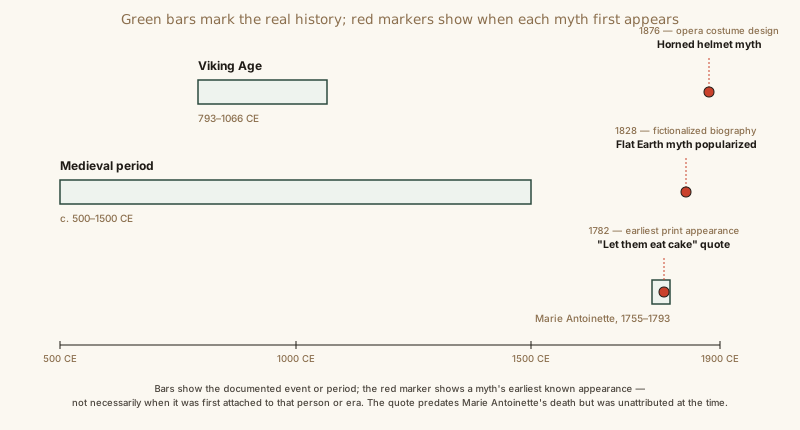
When these myths actually originated, versus the history they claim to describe
Lined up this way, the pattern is hard to miss: in each case, the myth's actual origin sits decades or even centuries after the historical period or person it claims to describe — a strong, recurring signal that a popular "historical fact" deserves a second look before being repeated as documented history.
Common mistakes
Common Mistakes
✕
Assuming a widely repeated historical detail must be true simply because it's so well known.
→ Wide repetition and documented accuracy are two different things — check when and where a claim first appears, not just how often it's repeated today.
✕
Treating every popular myth as a complete fabrication with no basis at all.
→ Some myths, like Napoleon's height, grow from a real detail that gets distorted or exaggerated over time — it's worth identifying the actual kernel of truth rather than dismissing the topic entirely.
✕
Assuming visual or dramatic historical images (like horned helmets) reflect how people at the time actually looked or lived.
→ Many enduring visual images of historical groups were created much later by artists, costume designers, or propagandists working from imagination or symbolism, not archaeological or documentary evidence.
Common misconception
“Vikings wore horned helmets into battle.”
No archaeological evidence supports Vikings wearing horned helmets in combat, or at all during the Viking Age (roughly 793–1066 CE). According to the National Museum of Denmark, the only ancient Scandinavian helmets ever found with horn-like features — the Veksø helmets — date to the Bronze Age, around 900 BCE, nearly two thousand years before the Viking Age began, and were most likely ceremonial objects rather than battle gear. The horned-helmet image widely associated with Vikings today traces to 19th-century Romantic-era art and costume design — notably costume designer Carl Emil Doepler's horned helmets for an 1876 staging of Richard Wagner's opera cycle Der Ring des Nibelungen — and was further popularized by Scandinavian nationalist art of the same period, roughly a millennium after the actual Viking Age ended.
Quick check
What does the archaeological evidence actually show about horned helmets and the Viking Age?
What to do next
What to do next
Next time you see a horned Viking helmet in a costume, cartoon, or logo, remember it's a 19th-century invention, not a Viking Age artifact.
When 'Napoleon complex' comes up, mention that his actual height was close to or above average for his time — the myth comes from a unit-conversion mix-up and British political cartoons, not fact.
Before repeating a striking historical quote, check whether it can be traced to a reliable source from the actual time and place — 'let them eat cake' is a good example of one that can't.
Notice how the 'medieval flat Earth' myth still gets cited today in unrelated arguments, and recognize that as a sign the myth is doing rhetorical work rather than describing real history.
FAQ
FAQ
Related terms
Related terms
Historiography
The study of how history is written and interpreted, including how myths, legends, and later embellishments become mixed in with the documented historical record over time.
Primary source
A firsthand account or original document from the time period being studied, as opposed to a later retelling — historians rely on primary sources to test whether a popular claim is actually documented.
Apocryphal
Describes a story or quote that is widely repeated and often treated as fact, but that lacks reliable historical evidence of actually happening or being said.
 KnowThis