 KnowThis
Key Takeaways
Key Takeaways
- 1Roughly 280 million people worldwide live outside their country of birth, per UN and IOM estimates — about 3.6% of the global population, and the large majority move for economic, family, or educational reasons rather than as refugees.
- 2Migration and forced displacement are related but distinct: refugees and asylum seekers make up a minority of international migrants overall, even though displacement numbers (over 100 million people forcibly displaced worldwide, per UNHCR) have reached record highs in recent years.
- 3Historical mass migrations — from prehistoric human dispersal out of Africa to the 19th-20th century transatlantic migration wave of tens of millions of Europeans — show that large-scale human movement driven by economic and environmental factors is a long-standing pattern, not a new phenomenon.
The concept
That distinction — between moving voluntarily for opportunity and being forced to flee — is the single most important dividing line in migration data, and it's worth seeing the actual scale of each category side by side.
Roughly what share of the world's approximately 280 million international migrants are refugees fleeing conflict or persecution?
Worked examples
Example 1: The Irish Potato Famine and 19th-century emigration (baseline case)
Example 2: Internal migration — a larger, less-visible category (edge case / variation)
A person relocates 1,500 km from a rural province to a major coastal city, entirely within their own country. Does this count in global 'international migrant' statistics?
Example 3: Modern conflict-driven displacement (real-world / applied case)
According to UNHCR's Global Trends reporting, the number of people forcibly displaced worldwide — including refugees, asylum seekers, and internally displaced persons — surpassed 100 million for the first time in 2022, driven substantially by conflicts including the war in Ukraine (which began in February 2022 and displaced millions of people both within Ukraine and across its borders into neighboring European countries) alongside continuing displacement linked to conflicts in Syria, Afghanistan, and elsewhere. This real-world case illustrates the conflict-driven displacement category specifically — distinct from, and smaller in total scale than, the broader roughly 280-million-person international migrant population, most of whom moved for economic or family reasons rather than fleeing violence.
How it works (visual)
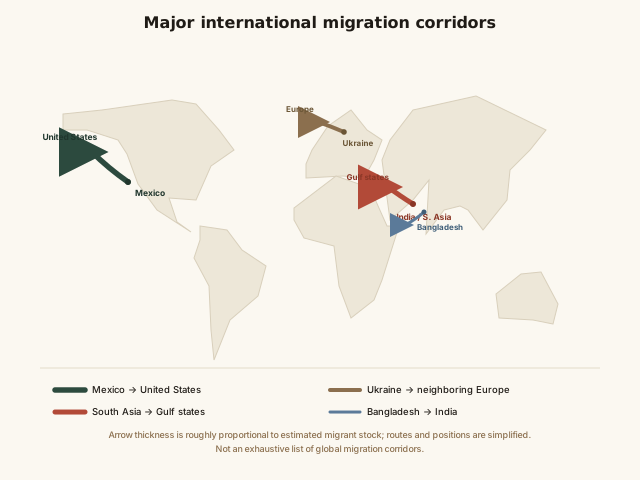
Notice that the thickest arrows on this kind of map generally represent long-standing economic migration corridors, built up over decades of labor demand and existing community ties, rather than the more sudden, conflict-driven flows that tend to dominate news coverage — both types are real and documented, but they differ substantially in scale, duration, and underlying cause.
Common mistakes
Common Mistakes
Using 'migrant' and 'refugee' interchangeably.
→ A refugee is a specific legal and humanitarian category — someone who has crossed an international border fleeing persecution or conflict. 'Migrant' is a much broader term covering anyone living outside their birth country for any reason, and refugees are a minority subset of that broader group.
Assuming all significant human migration is international.
→ Internal migration (within a single country) is a massive, well-documented phenomenon in its own right — China's internal rural-to-urban migration alone involves well over 100 million people, entirely separate from international migration statistics.
Treating large-scale human migration as a uniquely modern phenomenon.
→ Mass migration has occurred throughout human history, from prehistoric dispersal out of Africa to the 19th-20th century transatlantic migration wave that moved tens of millions of Europeans to the Americas.
Common misconception
“Most international migrants are refugees fleeing war or persecution.”
Refugees and asylum seekers are a real and significant category, and forced displacement numbers have reached record highs in recent years — UNHCR reported forcibly displaced people worldwide surpassing 100 million for the first time in 2022. But this group is a minority within the much larger population of roughly 280 million international migrants tracked by the UN and IOM. The large majority of international migrants move for economic opportunity, family reunification, or education — labor migration in particular has historically been, and remains, the largest documented driver of international movement by volume. Conflating "migrant" with "refugee" understates both the scale of ordinary economic and family-driven migration and the specific, distinct legal and humanitarian situation refugees face.
A news article uses 'migrant' and 'refugee' as fully interchangeable terms when describing global migration data. Is this accurate?
What to do next
What to do next
- Next time you read a migration-related headline, check whether it's describing international migrants broadly, refugees specifically, or internal migration — the three numbers tell very different stories.
- Look up the IOM World Migration Report for the latest documented figures on international migrant totals and major migration corridors.
- Check UNHCR's Global Trends report to see the current breakdown between refugees, asylum seekers, and internally displaced persons.
- Read the related entry on Urbanization Trends to see how internal, rural-to-urban migration connects to global city growth.