Languages by Region (overview, ties to Language topic)
The world's roughly 7,000 living languages cluster into a small number of large language families, are unevenly distributed by region — with Papua New Guinea alone home to over 800 languages — and are disappearing fast enough that linguists estimate close to 40% are currently endangered.
Reading time
— 5 min
Updated
— Aug 16, 2026
Fact-reviewed
— Aug 16, 2026
Key Takeaways
Key Takeaways
1Roughly 7,000 living languages are spoken worldwide, according to Ethnologue's ongoing catalog — but they're extremely unevenly distributed across regions, not spread evenly by population.
2Mandarin Chinese has the largest number of native speakers of any language, while English has the largest total number of speakers once second-language speakers are included — these are two different rankings that measure different things.
3Linguistic diversity concentrates heavily in specific regions: Papua New Guinea alone is home to over 800 living languages, more than any other single country, largely due to its isolated mountain and island geography.
The concept
Roughly 7,000 languages are spoken around the world today, but they aren't spread evenly — some regions are home to dozens or even hundreds of distinct languages packed into a small area, while other, larger regions are dominated by just a handful. Geography plays a huge role in this: mountains, islands, and dense rainforest tend to isolate communities from each other over long stretches of time, and isolated communities tend to develop increasingly distinct languages, while flat, open, well-connected terrain tends to favor a smaller number of languages spreading over a wider area.
That link between rugged, fragmented geography and extreme linguistic diversity is the single most useful pattern in this topic — the next check applies it directly.
Quick check
Papua New Guinea, a country of relatively modest population, is home to more than 800 distinct living languages — more than any other country. What's the leading geographic explanation for this?
Worked examples
Example 1: Mandarin vs. English — two different "most spoken" rankings (baseline case)
Asking "what's the most spoken language in the world" produces two different correct answers depending on the question actually being asked. By native speakers alone, Mandarin Chinese ranks first, with roughly 940 million people who learned it as a first language, concentrated overwhelmingly in China. By total speakers — native speakers plus everyone who learned it as a second or additional language — English ranks first, with estimates commonly cited around 1.5 billion total speakers, reflecting its widespread use as a second language in international business, science, aviation, diplomacy, and online communication across dozens of countries where it isn't anyone's native tongue. Neither ranking is "more correct" than the other; they simply measure different things, and a careful source always specifies which one it's using.
Example 2: Why Africa has the most language families of any continent (edge case / variation)
Africa is home to well over 2,000 distinct languages, spread across several major language families including Niger-Congo (the largest family in the world by number of individual languages), Afro-Asiatic, Nilo-Saharan, and Khoisan. This concentration reflects both Africa's enormous land area and geographic diversity — deserts, rainforests, savannas, and highland regions that historically separated communities — and its long, deep history of continuous human settlement, giving languages a very long span of time in which to diverge from common ancestors. This is a useful edge case because it shows linguistic diversity can be driven by scale and time depth, not just by rugged terrain the way Papua New Guinea's case is — a reminder that no single geographic factor explains every region's language pattern on its own.
Quick check
Which best explains why sub-Saharan Africa is home to such a high number of distinct language families, not just individual languages?
Example 3: Reading a language-endangerment map correctly (real-world / applied case)
UNESCO's Atlas of the World's Languages in Danger classifies endangered languages into tiers — vulnerable, definitely endangered, severely endangered, critically endangered, and extinct — based mainly on how many children are still learning the language as their first language, not simply how many total speakers remain. A language can have thousands of elderly speakers and still be classified as critically endangered if virtually no children are learning it, since that pattern predicts the language will have no native speakers left within a generation or two. This is why raw speaker counts alone can be misleading: understanding real endangerment risk requires looking at the age distribution of speakers and whether intergenerational transmission — parents actively teaching the language to their children — is still happening at all.
How it works (visual)
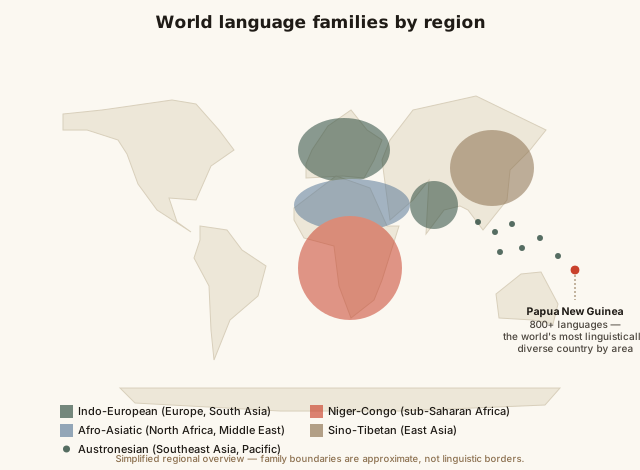
World language families and regional concentration of linguistic diversity
The map makes the regional pattern visible at a glance: large, contiguous language families cover most of the world's land area and population, while a small number of geographically fragmented regions — Papua New Guinea most dramatically — pack in a disproportionate share of the world's total language count. Both patterns come from the same underlying force: how much or how little geography has historically allowed neighboring communities to stay in regular contact with each other.
Common mistakes
Common Mistakes
✕
Treating 'most spoken language' as a single fixed ranking.
→ Check whether a ranking counts only native speakers (Mandarin Chinese leads) or total speakers including second-language speakers (English leads) — these produce different, equally valid answers to different questions.
✕
Assuming a country's number of languages roughly tracks its population size.
→ Papua New Guinea, with a comparatively modest population, has more distinct languages (800+) than far more populous countries — geographic isolation, not population, is the stronger predictor of language count.
✕
Judging a language's endangerment risk from its total number of remaining speakers alone.
→ UNESCO's endangerment classifications weigh whether children are still learning the language natively far more heavily than raw speaker counts — a language with thousands of elderly speakers can still be critically endangered if intergenerational transmission has stopped.
Common misconception
“Every country has essentially one main national language and a small number of minor dialects.”
Many countries are dramatically multilingual, not incidentally but structurally. Papua New Guinea alone is home to more than 800 living languages. India recognizes 22 scheduled languages in its constitution alongside hundreds of additional languages and dialects spoken across its states. Nigeria has well over 500 living languages. The tidy image of "one country, one language" fits some nations reasonably well but is a poor description of how language actually works across large parts of the world, where linguistic diversity within a single country's borders can rival or exceed the diversity found across an entire continent elsewhere.
Quick check
Which statement most accurately reflects how many languages the typical country has?
What to do next
What to do next
Look up which language family your own native language belongs to, and trace which other major world languages share that same family.
Next time you see a 'most spoken language' ranking, check whether it's counting native speakers or total speakers before comparing it to a different list.
Explore UNESCO's Atlas of the World's Languages in Danger to see which endangered languages are spoken nearest to where you live.
Read the entry on Religions by Region to see how a very similar geography-driven pattern — regional clustering shaped by history, migration, and terrain — shows up again with world religions.
FAQ
FAQ
Related terms
Related terms
Language family
A group of languages descended from a common ancestral language, such as the Indo-European or Sino-Tibetan family.
Native speaker
A person who learned and speaks a given language as their first language from early childhood.
Lingua franca
A language adopted as a common means of communication between speakers of different native languages, often for trade, diplomacy, or education.
Endangered language
A language at risk of falling out of use as its remaining speakers die out or shift to speaking a more dominant language instead.
Linguistic diversity
The number and variety of distinct languages spoken within a given region or country.
 KnowThis