Regional cuisines are shaped primarily by climate and geography, which determine what crops and animals a region can realistically produce, layered with centuries of trade, migration, and colonization that moved specific ingredients — like chili peppers, tomatoes, and spices — far beyond their original growing regions.
Reading time
— 6 min
Updated
— Aug 16, 2026
Fact-reviewed
— Aug 16, 2026
Key Takeaways
Key Takeaways
1A region's traditional cuisine starts with what its climate and soil can actually grow — rice-based diets cluster in monsoon Asia, wheat-based diets across temperate Europe and the Middle East, and corn-based diets across Mesoamerica, each tracking real agricultural geography.
2Many ingredients now considered essential to a region's cuisine arrived from somewhere else entirely — tomatoes and chili peppers, both native to the Americas, only reached Europe, Africa, and Asia after 1492, meaning Italian tomato sauce and spicy Indian and Thai dishes are both younger than commonly assumed.
3UNESCO formally recognizes specific food traditions as intangible cultural heritage — including the Mediterranean diet, French gastronomy, Japanese washoku, and Neapolitan pizza-making — treating food as living cultural practice, not just sustenance.
The concept
A region's traditional food doesn't develop randomly — it starts with geography. Climate and soil determine which crops grow well in a given place, and that available produce becomes the foundation of the local diet long before it becomes "cuisine" in a cultural sense. Rice thrives in the warm, wet conditions of monsoon Asia, so rice became the staple food across much of that region. Wheat handles drier, more temperate conditions better, so it became the staple across much of Europe, North Africa, and the Middle East. From there, centuries of trade, migration, conquest, and religious practice layered in flavors, techniques, and specific ingredients on top of that basic climate-driven foundation.
That gap between "ancient staple crop" and "recently arrived star ingredient" is the single most surprising thing about regional cuisine — the next check tests it directly.
Quick check
Tomatoes are considered a defining ingredient of traditional Italian cuisine today. Roughly how long has this actually been the case?
Worked examples
Example 1: Staple crops and monsoon geography in Asia (baseline case)
Across South and Southeast Asia — India, Bangladesh, Thailand, Vietnam, Indonesia, and beyond — rice serves as the dominant staple food, and this tracks directly with the region's monsoon climate: warm temperatures and heavy seasonal rainfall create ideal paddy-growing conditions across enormous areas of low-lying, well-irrigated land. This isn't a cultural preference layered independently on top of geography — it's a direct consequence of it, and it shows up in language and custom too, with "rice" and "meal" functioning as near-synonyms in several regional languages. By contrast, in drier parts of northern India and Pakistan, wheat plays a larger role in the everyday diet (naan, roti, chapati), reflecting a real shift in local growing conditions rather than an arbitrary cultural line drawn on a map.
Example 2: Chili peppers reshaping cuisines that never grew them natively (edge case / variation)
Chili peppers are native exclusively to the Americas, yet today they define much of what people consider "spicy" cuisine across South Asia, Southeast Asia, and parts of Africa — regions the chili pepper never touched before the 16th century. Portuguese traders introduced chili peppers to India and Southeast Asia via their maritime trade routes shortly after the plant's arrival in Europe from the Americas, and the crop was rapidly and widely adopted because it grew well in tropical and subtropical climates and offered an intense, popular flavor. Within a few generations, chili became so deeply embedded in regional cooking — Indian curries, Thai dishes, Sichuan Chinese cuisine — that its non-native origin is now a genuine surprise to most people, a striking edge case showing how fast an introduced ingredient can become perceived as ancient and essential to a cuisine's identity.
Quick check
Chili peppers are now considered essential to many South and Southeast Asian cuisines. Where were chili peppers originally domesticated?
Example 3: UNESCO recognition of food as living cultural heritage (real-world / applied case)
UNESCO's Representative List of the Intangible Cultural Heritage of Humanity includes several food traditions recognized specifically as living cultural practice worth safeguarding, not just recipes. Examples include the Mediterranean diet (recognized jointly by several countries including Italy, Greece, Spain, and Morocco for its shared social and dietary traditions), the traditional Mexican cuisine of the Michoacán community (recognized for its community-based, generations-old culinary system), the gastronomic meal of the French, Japanese washoku (traditional dietary culture, particularly associated with New Year celebrations), and the art of Neapolitan "Pizzaiuolo" pizza-making. This UNESCO recognition process treats regional cuisine the same way it treats music, dance, or craft traditions — as an evolving cultural practice tied to a specific community and place, reinforcing that food geography isn't just about ingredients, but about the social and seasonal practices — often tied directly to festivals and celebrations — built around preparing and sharing them.
How it works (visual)
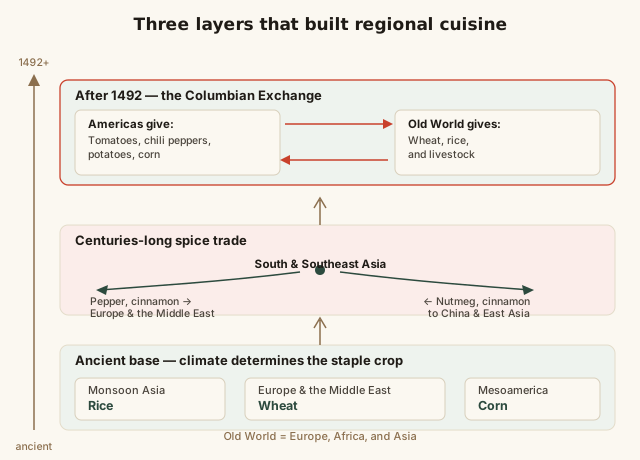
How climate, trade, and the Columbian Exchange shaped regional cuisines
The layered structure of the diagram is the key point: today's regional cuisines are built up in stages, not created all at once. The oldest layer is climate-determined staple crops; a middle layer added long-distance spice trade flavors over roughly two thousand years; and the most recent major layer, arriving abruptly after 1492, cross-transplanted entire categories of vegetables and staples between hemispheres that had never previously been in contact — reshaping what "traditional" food looks like in regions on both sides of the Atlantic within a few centuries.
Common mistakes
Common Mistakes
✕
Assuming a cuisine's most iconic ingredients have always been part of that region's cooking.
→ Check the ingredient's origin — tomatoes, chili peppers, potatoes, and corn are all native to the Americas and only reached Europe, Africa, and Asia after 1492, despite now being closely associated with cuisines on those continents.
✕
Treating regional cuisine as shaped purely by culture, with no connection to climate or agriculture.
→ Staple foods track real growing conditions closely — rice in wet, warm monsoon climates, wheat in drier temperate regions, corn across much of Mesoamerica — cultural preference builds on top of what a region's climate can actually produce, not independently of it.
✕
Assuming every region's cuisine developed in isolation, without outside influence.
→ Long-distance trade (the historical spice trade) and large-scale crop exchange (the Columbian Exchange) reshaped cuisines on every inhabited continent — very few major regional cuisines developed entirely free of outside ingredient influence.
Common misconception
“A country's most iconic dish or ingredient has always been part of its culinary tradition, going back centuries or millennia.”
Many now-iconic regional foods are considerably younger than assumed once you trace the ingredients themselves. Tomatoes reached Italy only after 1492, yet tomato sauce is now considered a defining feature of Italian cuisine. Chili peppers reached India and Thailand only in the 16th century via Portuguese trade routes, yet chili-based heat now defines much of how those cuisines are perceived internationally. Potatoes, essential to traditional Irish and German cooking today, are native to South America and were unknown in Europe before the 16th century. None of this makes these foods any less genuinely traditional today — centuries of continuous local use is a real and legitimate basis for culinary tradition — but "always been eaten here" is frequently a shorter timeline than it feels.
Quick check
Potatoes are considered a defining part of traditional Irish and German cuisine. What does food history tell us about how long this has actually been true?
What to do next
What to do next
Pick a dish you consider deeply traditional to a specific region and research the origin of its main ingredients — you may find at least one arrived from a different continent within the last 500 years.
Look up which staple crop (rice, wheat, corn, or another) dominates your own region's traditional diet, and connect it to your region's climate and growing conditions.
Browse UNESCO's Intangible Cultural Heritage list for food traditions to see which specific dishes and culinary practices have been formally recognized worldwide.
Read the entry on Climate Zones Explained to see the specific climate classifications that determine which staple crops a region can realistically grow.
FAQ
FAQ
Related terms
Related terms
Staple food
A food that forms the dominant, regularly eaten base of a region's diet, typically a grain, tuber, or other calorie-dense crop well suited to the local climate.
Columbian Exchange
The widespread transfer of plants, animals, foods, and diseases between the Americas and the rest of the world following Christopher Columbus's 1492 voyage.
Spice trade
The historical trade network, active for over two thousand years, that moved spices like pepper, cinnamon, and nutmeg from South and Southeast Asia to markets across Europe, the Middle East, and Africa.
Terroir
The combination of a specific region's soil, climate, and local growing conditions that gives an agricultural product (like wine grapes, coffee, or tea) a distinctive character tied to that place.
Intangible cultural heritage
UNESCO's category for living cultural practices — including food traditions, festivals, and crafts — recognized and safeguarded as significant to a community's identity.
 KnowThis