 KnowThis
Key Takeaways
Key Takeaways
- 1A wave transfers energy from place to place without permanently carrying the matter it moves through — a floating buoy bobs up and down as a wave passes but doesn't travel with it.
- 2Frequency and wavelength trade off at a fixed wave speed: higher frequency always means shorter wavelength, and vice versa, for a wave moving through the same medium.
- 3This one relationship — speed = frequency × wavelength — governs sound, light, radio waves, and ocean waves alike, even though they're physically very different phenomena.
The concept
That speed–frequency–wavelength relationship stops being abstract the moment you plug in real numbers for a sound you actually hear, which is exactly where it becomes something you can calculate.
A siren's pitch gets noticeably higher (higher frequency) while its speed through the air stays essentially constant. What must happen to its wavelength?
Worked examples
Example 1: Finding the wavelength of a musical note (baseline case)
Example 2: Why thunder booms low but lightning "cracks" high-pitched up close (edge case / variation)
Why does the same thunderclap sound like a sharp crack up close but a long, low rumble from several kilometers away?
Example 3: How noise-cancelling headphones use wave interference (real-world / applied case)
How it works (visual)
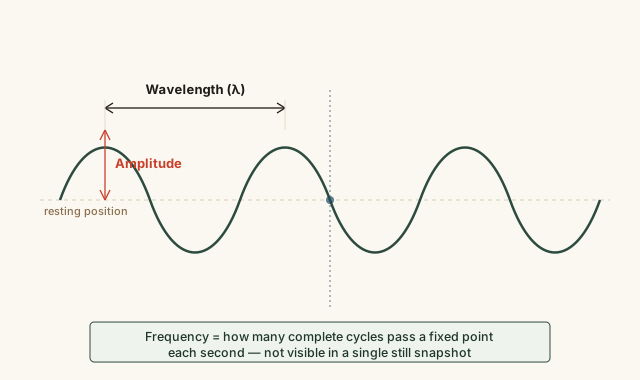
Wavelength is measured crest to crest; amplitude is measured from the resting line up to a crest (or down to a trough), and controls how much energy the wave carries — for sound, that's volume; for light, that's brightness. Frequency isn't directly visible on a single snapshot of the wave — it's how many of these crest-to-crest cycles pass a fixed point every second, which is why frequency depends on both the wavelength and how fast the wave is traveling.
Common mistakes
Common Mistakes
Thinking a water wave physically carries water from one place to another.
→ A floating object mostly bobs up and down in place as a wave passes — it's the disturbance and energy that travel forward, not the water itself, except for a small amount of net drift near the surface.
Assuming higher frequency and higher amplitude are the same thing.
→ Frequency is how many cycles happen per second (linked to pitch for sound, color for light); amplitude is how big each cycle is (linked to volume for sound, brightness for light) — they're independent properties.
Believing sound can travel through the vacuum of space like light does.
→ Sound is a mechanical wave that needs a physical medium (like air) to compress and carry it — it cannot travel through a true vacuum, unlike electromagnetic waves such as light, which need no medium at all.
Common misconception
“A wave moving across the ocean physically pushes water from far away all the way to shore.”
Ocean waves are overwhelmingly a transfer of energy through water, not a bulk transport of the water itself. A piece of floating debris riding a wave mostly moves in a small circular or elliptical loop as each wave passes, ending up close to where it started, rather than being carried the full distance the wave traveled. Genuine large-scale water transport toward shore does happen, but through separate mechanisms like currents and the final wave-breaking process near the beach — not the open-ocean wave motion itself.
A cork floats on the ocean far from shore as waves pass beneath it. What does the cork mostly do as each wave passes?
Try it yourself
What to do next
What to do next
- Watch a floating leaf or debris in a pond as ripples pass beneath it — notice it mostly bobs in place rather than riding the wave to the edge.
- Try the calculator above with a bass note (~80 Hz) versus a high whistle (~4,000 Hz) at the same 343 m/s speed to see the wavelength difference.
- Next time thunder rumbles from a distance, connect the low, drawn-out sound to high frequencies being absorbed by the air over that distance.
- Read the related entry on Light, Color & Sound to see how this same wave math applies to the electromagnetic spectrum.