 KnowThis
Key Takeaways
Key Takeaways
- 1Each sense relies on specialized receptor cells that convert one specific type of physical or chemical energy — light, sound waves, chemicals, or pressure — into an electrical nerve signal.
- 2Smell and taste are both chemical senses that work together to create 'flavor' — most of what people call taste is actually smell, which is why food seems bland with a blocked nose.
- 3The brain, not the sense organ itself, does the actual interpreting — and researchers formally recognize additional senses beyond the classic five, including balance and body position.
The concept
Smell and taste are the two senses most people confuse for each other, and understanding exactly how they divide the work is where the concept gets genuinely useful.
Food loses most of its 'taste' when someone has a stuffy nose from a cold. What does this best demonstrate?
Worked examples
Example 1: How vision converts light into a brain signal (baseline case)
Example 2: Genetic differences in taste sensitivity — "supertasters" (edge case / variation)
Two people eat the same bitter vegetable, and one finds it much more intensely bitter than the other, even though both have a normal, healthy sense of taste. What's the most likely explanation?
Example 3: Losing smell and its effect on eating (real-world / applied case)
Temporary or long-term loss of smell (anosmia) — common during a cold, and documented as a symptom of some viral infections — doesn't eliminate taste itself, but it removes most of what people experience as "flavor." Someone with anosmia can typically still detect basic tastes (a food is sweet, salty, sour, bitter, or savory) using their tongue alone, but complex flavors like the specific taste of coffee, chocolate, or a particular fruit rely heavily on aroma molecules reaching olfactory receptors through the back of the throat. This is a genuine, testable real-world demonstration of the two senses working as one system: pinch your nose while eating something with a distinct aroma, like chocolate, and the basic sweetness remains but much of the specific "chocolate" character disappears until you release your nose.
How it works (visual)
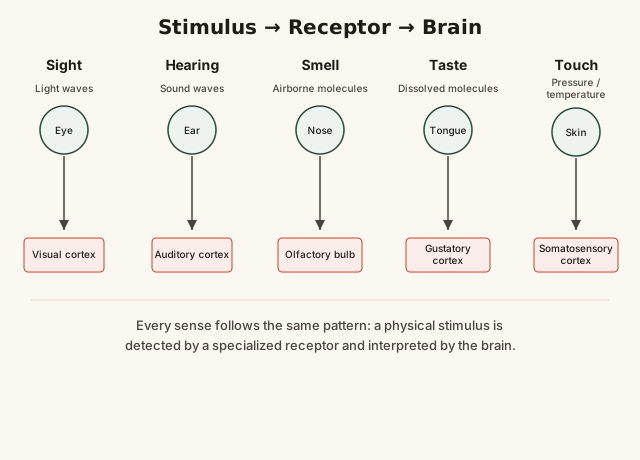
Notice that every column follows the same three-step pattern — stimulus, receptor, brain — even though the physical signal being detected is completely different in each case. That shared structure is the real unifying idea behind "the senses": they're not five unrelated systems, but five different applications of the same basic strategy of converting outside information into a nerve signal the brain can use.
Common mistakes
Common Mistakes
Believing the tongue has distinct zones — a 'sweet zone' at the tip, a 'bitter zone' at the back — that only detect one taste each.
→ All five taste types (sweet, salty, sour, bitter, umami) can be detected across most areas of the tongue that have taste buds, with only minor, not exclusive, sensitivity differences by region.
Treating 'taste' and 'flavor' as the same thing.
→ Taste is the tongue's narrow detection of sweet/salty/sour/bitter/umami; flavor is the fuller experience built mostly from smell combined with taste — which is why flavor, not taste, disappears with a blocked nose.
Assuming touch is a single, uniform sense.
→ Skin actually uses several distinct receptor types for pressure, vibration, temperature, and pain, which is why you can feel a light touch and a burn as completely different sensations rather than varying intensities of the same one.
Common misconception
“The tongue has a 'map' of zones — sweet at the tip, sour and salty on the sides, bitter at the back — that each detect only one taste.”
The tongue map is a well-documented myth traced back to a 1901 German study by researcher D.P. Hänig, which measured only slight regional differences in taste sensitivity threshold — how little of a substance was needed to detect it — not exclusive zones. When the study was translated and popularized in English decades later, those small sensitivity differences were exaggerated into a strict map with sharply divided regions. In reality, taste buds capable of detecting sweet, salty, sour, bitter, and umami are distributed across most of the tongue's surface, with only mild variation in sensitivity between regions — not the rigid, zone-based diagram still printed in some textbooks.
A popular diagram shows the tongue divided into separate zones, each detecting only one taste. What does current sensory research say about this diagram?
What to do next
What to do next
- Pinch your nose while eating something with a strong aroma (like chocolate or coffee) to directly experience how much of 'flavor' actually comes from smell.
- Next time you see a tongue-map diagram, recognize it as an outdated myth rather than accurate anatomy.
- Notice the difference between a light touch, a vibration, and heat on your skin, and connect each to a distinct type of touch receptor rather than one general 'touch' sense.
- If smell or taste loss lasts more than a few weeks without an obvious cause like a cold, check with a healthcare provider rather than assuming it will resolve on its own.