 KnowThis
Key Takeaways
Key Takeaways
- 1Most everyday 'speed math' situations reduce to one of a few repeatable patterns — percentage of a number, unit price comparison, or splitting a total evenly — recognizing the pattern is faster than reinventing the arithmetic each time.
- 2Successive discounts and price changes stack multiplicatively, not additively: a 20% discount followed by a 10% discount leaves you paying 0.8 × 0.9 = 72% of the original price, a 28% total discount, not 30%.
- 3Comparing unit price (price per ounce, per item) rather than sticker price is the fastest reliable way to tell which of two differently sized options is the better deal — and the bigger package isn't always the cheaper one per unit.
The concept
A $50 jacket is 20% off. What is the sale price?
Worked examples
Example 1: Estimating sales tax at checkout (baseline case)
Example 2: Two discounts stacked in sequence (edge case / variation)
A $200 TV is discounted 30%, then an extra 15% is taken off at checkout. What is the final price?
Example 3: Comparing unit prices between two package sizes (real-world / applied case)
A "value size" bag of coffee is 30 oz for $12.99. A "standard" bag of the same coffee is 12 oz for $4.99. It's tempting to assume the bigger bag is automatically the better deal, but check the unit price instead: the value bag costs $12.99 ÷ 30 = $0.433 per ounce, while the standard bag costs $4.99 ÷ 12 = $0.416 per ounce. The smaller standard bag is actually slightly cheaper per ounce, despite the "value size" label. Dividing price by quantity, rather than comparing total sticker prices, is the only reliable way to catch cases like this — and larger package sizes are not always the better per-unit deal, contrary to what shoppers usually assume.
How it works (visual)
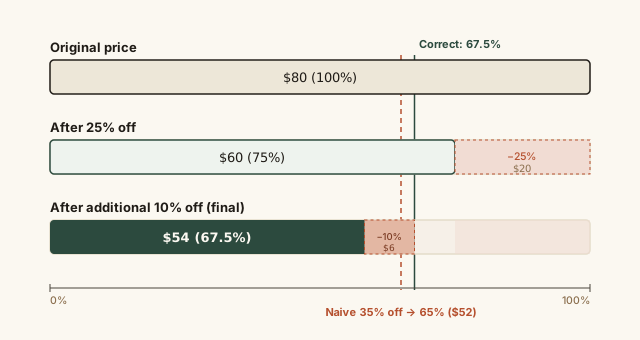
Each discount shortens whatever bar length remains at that point, not the original full-length bar. That's the entire visual explanation for why stacked percentages multiply instead of add: the second discount has a smaller base to work from than the first one did, so it removes a smaller absolute amount even though its percentage rate is applied in full. The gap between the correctly stacked endpoint (67.5%) and the naively added endpoint (65%) is small in this example, but it grows quickly with larger percentages or more discounts stacked in sequence.
Common mistakes
Common Mistakes
Adding two successive percentage discounts together instead of multiplying the remaining fractions (treating 25% off then 10% off as 35% off).
→ Apply each discount to the price that remains after the previous one, multiplying the remaining fractions: (1 - 0.25) × (1 - 0.10) = 0.675, a 32.5% total discount, not 35%.
Comparing total sticker prices between different package sizes instead of unit prices.
→ Divide each price by its quantity (price ÷ ounces, price ÷ item count) before comparing. The bigger package is not automatically the cheaper one per unit.
Defaulting to a familiar percentage (like always estimating with 10%) without adjusting it to match the actual required rate.
→ Use 10% as a starting benchmark, then scale it up or down to the actual rate needed — for an 8% tax, subtract a fifth of the 10% figure; for a 15% tip, add half of it.
Common misconception
“A 20% discount followed by another 10% discount is the same as one 30% discount.”
It isn't — the two discounts multiply the remaining fraction rather than adding the percentages. The first discount leaves 80% of the price (a multiplier of 0.8); the second discount removes 10% of that already-reduced amount, leaving 90% of it (a multiplier of 0.9). Combined, the buyer pays 0.8 × 0.9 = 0.72, or 72% of the original price — a 28% total discount, not 30%. The same logic runs in the other direction too: a 50% pay cut followed by a 50% raise doesn't return you to your original salary; it leaves you at 0.5 × 1.5 = 0.75, or 75% of where you started.
An item's price goes up 50% one month, then down 50% the next month. Is the final price the same as the original price?
Try it yourself
What to do next
What to do next
- Next time you see two stacked discounts advertised, compute the actual combined multiplier ((1 - first%) × (1 - second%)) instead of adding the two percentages.
- Before buying the larger of two package sizes, do the quick division for unit price on both — don't assume bigger is automatically cheaper per unit.
- Practice the '10%, then scale' method for estimating tax and tips on a few real receipts until the scaling step (halving for 5%, fifths for 2%) becomes automatic.
- Read the related entry on Percentages Explained for the full mechanics of percentage change, percentage points, and percent-of-a-percent calculations.