 KnowThis
Key Takeaways
Key Takeaways
- 10.999... (a 9 repeating forever) is not 'almost 1' or 'approaching 1' — it is mathematically exactly equal to 1, provable directly with basic algebra.
- 2Zeno's paradox of a runner who must first cross half the remaining distance, then half of what's left, forever, is resolved by the fact that an infinite number of terms can still sum to a finite total.
- 3Simpson's paradox shows that a trend true in every individual subgroup of data can reverse completely once the subgroups are combined — a reminder that averaging data can hide, not just reveal, the truth.
The concept
Before working through the runner and the repeating decimal side by side, it helps to see how directly they connect — both are really the same trick of infinitely many shrinking pieces summing to something finite and exact.
Is 0.999... (repeating forever) slightly less than 1, or exactly equal to 1?
Worked examples
Example 1: Summing Zeno's halving series (baseline case)
Example 2: Simpson's paradox with real batting-style numbers (edge case / variation)
In Simpson's paradox, how can Batter A appear to have an advantage in isolated comparisons, yet Batter B ends up with the better combined season average?
Example 3: The infinite hotel (real-world / applied illustration of infinity)
Imagine a hotel with infinitely many rooms, numbered 1, 2, 3, and so on, and every room is already occupied. A new guest arrives — can they be accommodated? Yes: ask every current guest to move from room n to room n + 1 (room 1's guest moves to room 2, room 2's guest moves to room 3, and so on). Room 1 is now empty for the new guest, and because the hotel has infinitely many rooms, nobody runs out of a room to move into. This thought experiment, known as Hilbert's Hotel after mathematician David Hilbert, illustrates that infinite quantities behave in ways that flatly violate intuition built on finite quantities — "full" and "has room for one more" can both be true at once, but only when infinity is genuinely involved.
How it works (visual)
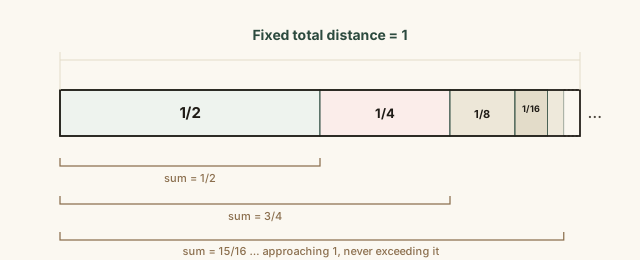
Every piece added to the running sum is exactly half the size of the gap still remaining, which guarantees two things simultaneously: the sum keeps growing after every single step (it never stalls), and it can never exceed the full length of the line (there's always a smaller sliver left to add). Those two facts together are precisely what a mathematical limit captures — the sum approaches the total distance as closely as you like, and in the limit of infinitely many steps, it equals that distance exactly.
Common mistakes
Common Mistakes
Assuming 'infinite steps' automatically means 'infinite time' or 'never finishes.'
→ Separate the count of steps from the total distance or time they cover — infinitely many steps can still sum to a small, finite quantity, exactly like Zeno's halving distances summing to a normal finite length.
Treating 0.999... as merely 'very close to' 1 rather than exactly equal to it.
→ Remember there is no real number strictly between 0.999... and 1 — and if two numbers have nothing between them, they are, by definition, the same number.
Trusting a combined statistic without checking whether it was built from unevenly sized subgroups.
→ When comparing rates or averages built from different-sized samples, check the subgroup trends individually before trusting the combined figure — Simpson's paradox shows the combined number can mislead.
Common misconception
“A math 'paradox' means mathematics has actually found a genuine contradiction or a flaw in logic.”
Every paradox covered here is fully resolved — none of them represents an actual, unresolved contradiction in mathematics. Zeno's runner does arrive (infinite series converge to finite sums); 0.999... does equal 1 (no number sits between them); Simpson's paradox produces two statistically valid but differently framed numbers, not a logical error. What makes something a "paradox" in math is that it violates untrained intuition, not that it violates logic — the mathematics itself stays perfectly consistent throughout, which is exactly why each of these can be proven, not just argued about.
If a math paradox is fully resolved and provably consistent (like Zeno's or 0.999...=1), why do mathematicians still call it a 'paradox' instead of just a normal fact?
Try it yourself
What to do next
What to do next
- Work through the algebra proof that 0.999... = 1 by hand (let x = 0.999..., compute 10x - x) until the steps feel natural, not just memorized.
- Use the calculator above to see how quickly the 'remaining distance' shrinks toward zero — notice it never technically hits zero, no matter how many steps you enter.
- Next time you see an average built from combined subgroups (test scores by class combined into a school average, survey results by region combined nationally), ask whether Simpson's paradox could be hiding a reversed trend.
- Read the related entry on Math Puzzles & Logic Riddles for more places where careful step-by-step reasoning beats a fast, intuitive guess.