A percentage discount multiplies a price by (1 minus the discount rate), and applying two discounts in sequence multiplies the price by both remaining fractions, which is always less savings than adding the two percentages together.
Reading time
— 5 min
Updated
— Aug 16, 2026
Fact-reviewed
— Aug 16, 2026
Key Takeaways
Key Takeaways
1A percentage discount multiplies the price by (1 minus the discount rate) — 20% off means paying 80% of the original price, not subtracting 20 from the price directly.
2Two discounts applied in sequence multiply, they don't add: 20% off then 10% off is not 30% off — it's a smaller combined discount, about 28%.
3A markup followed by an equal-percentage discount (or vice versa) never returns the original price, because each percentage is calculated on a different base amount.
The concept
A discount rate of 25% means you pay 75% of the sticker price. A $80 item at 25% off costs 80 × 0.75 = $60. The trickier case is a "stacked discount" — two discounts applied one after another, like "25% off, plus an extra 10% off at checkout." It's tempting to add those to 35% off, but that's not how it actually works: the second discount applies to the already-discounted price, not the original one, so the real combined savings is always a little less than simply adding the two percentages.
The algebra above explains why stacking underperforms addition, but the effect is easiest to actually feel by running one concrete stacked-discount example start to finish.
Quick check
A $100 item is marked '30% off, plus an extra 20% off at checkout.' What is the final price?
Worked examples
Example 1: A single straightforward percentage discount (baseline case)
A $150 jacket is 40% off. Final price = 150 × (1 − 0.40) = 150 × 0.60 = $90. The savings is 150 − 90 = $60, which also checks out directly as 150 × 0.40 = $60. This is the simplest case: one discount rate applied once to one starting price.
Example 2: Two stacked discounts vs. their naive sum (edge case / variation)
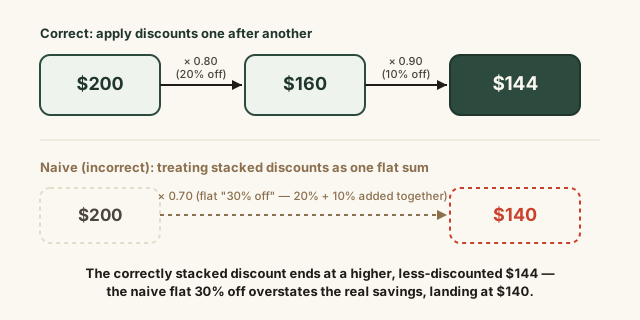
A $200 item is "20% off, plus an additional 10% off." Applied correctly: 200 × (1 − 0.20) = $160, then 160 × (1 − 0.10) = $144. Total savings: 200 − 144 = $56, which is a 28% effective discount (56 ÷ 200 = 0.28) — not the 30% a shopper might expect from simply adding 20% + 10%. The gap here (28% actual versus 30% naive) is modest with two smaller discounts, but the same algebra applied to two 50% discounts stacked together shows the effect scaling up sharply: 200 × 0.50 × 0.50 = $50 final price, a 75% effective discount — well short of the "100% off, i.e., free" a naive addition of 50% + 50% would incorrectly suggest.
Quick check
A store stacks two 50%-off discounts on the same item, one after another. Does this make the item free (100% off)?
Example 3: Why a 50% markup followed by a 50% discount doesn't return the original price (real-world / applied case)
A retailer buys an item for $80 and marks it up 50% for the sticker price: 80 × 1.50 = $120. Later, the item goes on sale for "50% off": 120 × 0.50 = $60. The final $60 sale price is actually below the original $80 cost — not because the retailer is taking a bigger loss than expected by symmetry, but because the 50% markup was calculated on the smaller $80 base, while the 50% discount was calculated on the larger $120 base. Equal percentages applied to two different base amounts almost never produce numbers that cancel out to the original value — the only case where markup-then-discount returns to the exact starting price is when the two percentages are deliberately chosen to be unequal in a specific, calculated way, not when they're the same round number.
How it works (visual)
Stacked discounts: 20% off then 10% off, applied to a $200 item
The two arrows in the correct path each shrink the running price by a multiplying factor, and multiplying two factors that are each less than 1 together always produces a smaller reduction than subtracting their percentages from 1 in one step — which is exactly why the correctly stacked path ($144) lands above the naive flat-30%-off path ($140). The gap between the two paths is the visual signature of exactly how much "extra" a naive addition overstates the real savings.
Common mistakes
Common Mistakes
✕
Adding two stacked discount percentages together instead of multiplying the remaining-price fractions in sequence.
→ Apply each discount one at a time to the running price (multiply by 1 minus each rate in turn), then compare the final result to the original price to find the true effective discount.
✕
Assuming a markup and an equal-percentage discount cancel each other out to return the original price.
→ Remember each percentage is calculated on a different base amount — the markup's base is the lower original price, while the discount's base is the higher marked-up price.
✕
Treating a percentage discount as a flat dollar subtraction from the price rather than a multiplication.
→ Convert the percentage to a decimal and multiply the price by (1 minus that decimal) — '20% off $50' means 50 × 0.80 = $40, not simply 50 − 20 = $30.
Common misconception
“Two stacked percentage discounts are equivalent to one discount equal to their sum — 'save 20%, plus an extra 10%' is the same as '30% off.'”
Stacked discounts multiply the remaining fraction of the price at each step rather than adding the percentages. A $200 item with 20% off then 10% off ends at $144 (a 28% effective discount) — slightly less generous than a straight 30% off, which would land at $140. The gap between the naive sum and the true stacked result grows larger the bigger the individual discount percentages are.
Quick check
Why does a stacked '20% off, then 10% off' end up being a smaller total discount than a flat '30% off' on the same starting price?
Next time you see a stacked discount ('X% off, plus an extra Y% off'), use the calculator above to find the real final price instead of mentally adding the percentages.
Compare the true effective discount percentage (savings ÷ original price) against the naive sum to see exactly how much smaller it really is.
If you see a price that was marked up and is now 'on sale' at the same percentage, calculate both steps separately to check whether it's genuinely below the original cost.
Practice converting a percentage discount to its multiplying factor (100% − discount%) before doing the arithmetic, rather than subtracting the discount from the price directly.
FAQ
FAQ
Related terms
Related terms
Discount rate
The percentage subtracted from a price, expressed as a decimal when used in calculation (20% becomes 0.20).
Stacked discount
Two or more discounts applied one after another to the same item, each calculated on the price remaining after the previous discount.
Markup
A percentage increase applied to a cost or price, calculated the same way as a discount but adding instead of subtracting.
Effective discount
The single overall percentage a combination of stacked discounts actually removes from the original price, which is always less than the sum of the individual percentages.
 KnowThis