English didn't begin as one fixed language and stay that way — it started as a West Germanic dialect brought to Britain in the 5th century CE, then was reshaped in turn by Old Norse, Norman French, and a continuous stream of borrowed vocabulary into the language spoken today.
Reading time
— 5 min
Updated
— Aug 16, 2026
Fact-reviewed
— Aug 16, 2026
Key Takeaways
Key Takeaways
1English isn't one unbroken language — it moved through four distinct stages (Old, Middle, Early Modern, and Modern English), and Old English is close to unreadable to a modern speaker without training.
2Two invasions did more than anything else to shape the language: Viking settlement (8th–11th centuries) added everyday Old Norse words, and the Norman Conquest (1066) buried English under three centuries of French as the language of power.
3The Great Vowel Shift (roughly 1400–1700) changed how English vowels were pronounced after much of the spelling was already fixed by early printing — which is the root cause of English's notoriously inconsistent spelling-to-sound match.
The concept
English started as a West Germanic language spoken by Angles, Saxons, and Jutes who settled in Britain starting around 450 CE, pushing the existing Celtic-speaking population to the edges of the island. That early form, called Old English, looked and sounded almost nothing like English today. Over the next 1,500 years, English absorbed huge waves of vocabulary from Old Norse (Viking settlers), French (after the Norman Conquest of 1066), and Latin and Greek (through scholarship, science, and the church) — while its grammar simplified dramatically. The language kept the same name the whole time, but it changed so much that a modern English speaker can't read Old English without studying it as a separate language.
That gap between Beowulf's English and today's is exactly why "how did English get here" is a genuinely useful question — the answer runs through a small number of specific historical collisions, not a slow, even drift.
Quick check
Why is Old English largely unreadable to a modern English speaker?
Worked examples
Example 1: Old Norse settles into everyday English (baseline case)
Viking raids and settlement in England from the late 8th century through the 11th century — especially in the northern and eastern region under Norse control known as the Danelaw — left Old Norse loanwords embedded in the most basic, everyday layer of English vocabulary, not just specialized terms. Words like "sky," "skin," "leg," "egg," "knife," "window," and even the pronouns "they," "them," and "their" all come from Old Norse, replacing or sitting alongside the original Old English equivalents. That pronouns — one of the most resistant parts of any language's grammar to outside change — were borrowed at all shows how deeply Norse settlers and English speakers lived side by side rather than as separate, occasional contacts.
Example 2: The Norman Conquest splits English vocabulary by class (variation / exception case)
After William the Conqueror's victory at Hastings in 1066, Norman French became the language of the court, law, and the nobility, while English remained the language of the majority working population — for roughly three centuries. That social split shows up today as pairs of words for the same thing: the animal in the field kept its Old English name (cow, pig, sheep, calf, tended by English-speaking farmers) while the meat served at the table took the French name (beef, pork, mutton, veal, eaten by the French-speaking nobility). This same pattern shows up across law (jury, verdict, judge), government (parliament, sovereign, council), and religion (sermon, chapel) — nearly all French-derived, because those were institutions the Norman ruling class controlled.
Example 3: English's history is still visible in spelling irregularities today (real-world / applied case)
English spelling often looks inconsistent — "through," "though," "tough," and "thought" all use "ough" but sound nothing alike — largely because spelling was substantially fixed by early printers in the late 1400s and 1500s, right as the Great Vowel Shift was still reshaping how those same words were actually pronounced. The written form froze while the spoken form kept moving, which is why a word like "knight" still spells out a "k" and a "gh" sound that stopped being pronounced centuries ago. Recognizing this history is genuinely useful: most of English's "illogical" spelling isn't random, it's a fossil record of an older pronunciation.
Quick check
Why do English speakers say 'cow' for the live animal but 'beef' for the meat, and 'pig' but 'pork'?
How it works (visual)
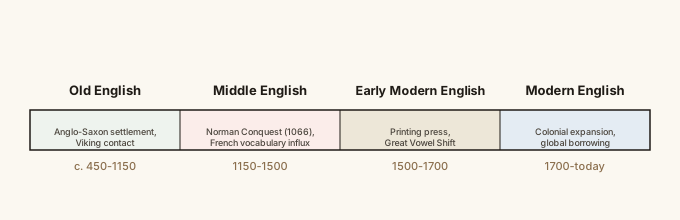
Four stages of English, from Old English to today
Each boundary on the timeline lines up with a specific historical disruption — settlement, conquest, or a technological shift like printing — rather than a slow, even drift, which is why English changed in such distinct bursts instead of gradually.
Common mistakes
Common Mistakes
✕
Assuming Old English is just an older-sounding version of Modern English, readable with a little patience.
→ Old English has different vocabulary, spelling, and grammar (heavy use of word-ending inflections) — it genuinely requires separate study, the way Modern German would.
✕
Calling Shakespeare's English 'Old English.'
→ Shakespeare wrote in Early Modern English (late 1500s–early 1600s), roughly 450 years after the Old English period ended — it's largely readable today, unlike genuine Old English.
✕
Treating English's history as one smooth, continuous evolution.
→ The biggest shifts came from sudden historical events — Viking settlement, the Norman Conquest, and the printing press locking in spelling — not gradual, even change over time.
Common misconception
“English has always been basically one stable, unchanging language, just spoken a bit differently by 'old-fashioned' people in the past.”
English has gone through genuinely dramatic phases — Old English was a heavily inflected Germanic language essentially unreadable to modern speakers, Middle English absorbed thousands of French words after the Norman Conquest and lost most of that inflection, and Early Modern English's pronunciation shifted enormously during the Great Vowel Shift even as spelling was becoming fixed. "English" is really a continuous label applied to what has been, at different points, a strikingly different language in vocabulary, grammar, and sound.
Quick check
Which of these best describes how English has changed over its history?
What to do next
What to do next
Next time an English spelling looks 'illogical' (like 'knight' or 'through'), remember it's often a fossil of an older pronunciation, not a random inconsistency.
When you notice an animal/meat word pair (cow/beef, pig/pork, sheep/mutton), recognize it as a direct trace of the Norman Conquest's class divide.
Try reading a short passage of Old English (like the opening of Beowulf) side-by-side with a translation to feel how far the language has actually moved.
Read the entry on Loanwords in English next to see how borrowing from French, Latin, and beyond continued well past the Middle English period.
FAQ
FAQ
Related terms
Related terms
Old English
The earliest stage of English (roughly 450–1150 CE), a West Germanic language brought to Britain by Anglo-Saxon settlers — largely unreadable to modern English speakers without study.
Middle English
The stage of English (roughly 1150–1500 CE) that followed the Norman Conquest, marked by heavy French vocabulary borrowing and simplified grammar — the English of Chaucer's Canterbury Tales.
Great Vowel Shift
A major, gradual change in how English long vowels were pronounced, occurring roughly between 1400 and 1700 — a key reason English spelling and pronunciation often don't match.
Norman Conquest
William the Conqueror's 1066 invasion of England, which installed a French-speaking ruling class and made Norman French the language of law, government, and the court for roughly three centuries.
 KnowThis