A handful of grammar mistakes — subject-verb agreement errors, dangling modifiers, mismatched pronouns, and mixed-up homophone pairs — account for most of the errors that make otherwise-good writing look sloppy.
Reading time
— 5 min
Updated
— Aug 17, 2026
Fact-reviewed
— Aug 17, 2026
Key Takeaways
Key Takeaways
1A small set of grammar mistakes — subject-verb agreement, dangling modifiers, homophone mix-ups, and pronoun mismatches — accounts for most everyday writing errors.
2Most of these mistakes happen because English sentences can get long enough to lose track of what agrees with what, not because the underlying rule is obscure.
3Each mistake has a fast diagnostic test you can run on a sentence before you publish or send it.
The concept
Most grammar mistakes people actually make aren't exotic rule violations — they're a short, repeating list: making a verb agree with the wrong noun, describing a phrase so it seems to modify the wrong word, mixing up sound-alike words like "their" and "there," or using "who" when "whom" is technically correct. None of these require deep grammar theory to fix — they need a quick, specific check.
Each of these error types has a specific, mechanical test that catches it — which is far more reliable than trying to "hear" whether a sentence sounds right.
Quick check
'The list of ingredients are on the back of the box.' What's the grammar error, and how do you fix it?
Worked examples
Example 1: Finding the true subject in a long sentence (baseline case)
"The results of the study, which took three years to complete, was surprising." The verb "was" needs to agree with the true subject, "results" — but "results" is plural, so it should be "were." The confusion comes from the long descriptive clause ("which took three years to complete") sitting right before the verb, making "complete" feel like it should influence the verb choice, when really the only word that matters is the original subject, "results." The fix: mentally delete every modifying phrase and clause, leaving just subject and verb — "The results... was surprising" immediately sounds wrong once the distracting middle section is gone, revealing it should be "were."
Example 2: A dangling modifier that changes the meaning (edge case / variation)
"After reviewing the budget, the project was approved." Grammatically, "after reviewing the budget" is a modifier with no stated subject of its own — it needs to attach to whoever did the reviewing. But the next word after the comma is "the project," which can't review anything. The sentence technically implies "the project" reviewed the budget and then approved itself. The fix requires naming who actually did the reviewing: "After reviewing the budget, the committee approved the project," or "After the committee reviewed the budget, the project was approved." This kind of error is extremely common in professional writing specifically because passive voice (see the Active vs Passive Voice entry) often drops the doer of the action, leaving the introductory modifier with nothing correct to attach to.
Example 3: Homophone errors that spellcheck won't catch (real-world / applied case)
"Their going to announce the results tomorrow, and its going to change everything." Both "their" and "its" are wrong here — "Their" should be "They're" (they are), and "its" should be "it's" (it is). Standard spellcheck tools won't flag either error, because "their" and "its" are both correctly spelled real words — the mistake is choosing the wrong real word, not misspelling one. This is exactly why homophone errors survive into published writing more often than obvious typos: automated tools check spelling, not word choice, so catching these requires either careful proofreading or a grammar-checking tool that specifically models sentence meaning, not just dictionary lookup.
Quick check
'Everyone at the conference brought their own laptop.' Is 'their' used correctly here, even though 'everyone' is grammatically singular?
How it works (visual)
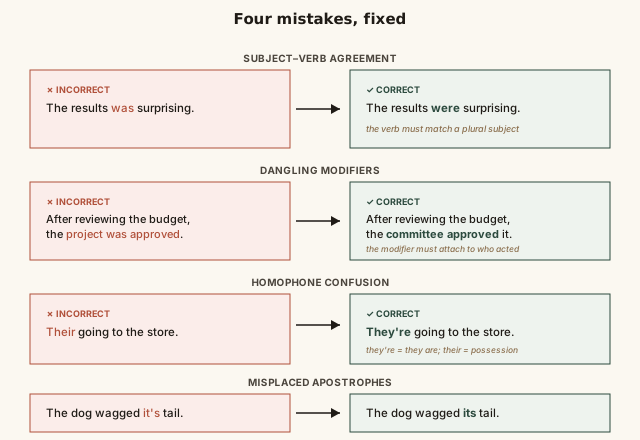
Four common grammar mistakes and their fixes
Notice that three of the four categories in the diagram are really about tracking down the true subject or doer of an action in a long sentence — agreement errors, dangling modifiers, and even some homophone slips often trace back to losing track of "who or what is this sentence actually about" once other words pile up around it.
Common mistakes
Common Mistakes
✕
Matching a verb to the nearest noun instead of the true subject in a long sentence.
→ Mentally strip out modifying phrases and clauses to isolate the actual subject before choosing the verb form.
✕
Starting a sentence with a modifying phrase that has nothing correct to attach to.
→ Check that the word immediately after the introductory phrase is the one actually doing the action described in that phrase.
✕
Relying on spellcheck to catch homophone errors (their/there/they're, your/you're, its/it's).
→ Read the sentence specifically checking word choice, not spelling — spellcheck won't flag a correctly-spelled wrong word.
✕
Assuming 'who' is always correct and 'whom' is always overly formal (or vice versa).
→ Use 'who' for the subject of a clause ('who called?') and 'whom' for the object ('to whom should I address this?') — or substitute 'he/she' (who) versus 'him/her' (whom) as a quick test.
Common misconception
“Good writers never make grammar mistakes — errors are a sign of carelessness or poor education.”
Even highly skilled, professionally published writers make these exact mistakes regularly in first drafts — subject-verb agreement errors and dangling modifiers are notoriously easy to introduce while revising a sentence (moving a clause around can accidentally separate a subject from its verb, or strand a modifier). What separates careful writers isn't an absence of first-draft errors, it's a reliable editing pass that specifically checks for these known trouble spots before publishing — which is a learnable habit, not an innate talent.
Quick check
'Reaching for the top shelf, the ladder wobbled.' What's wrong with this sentence?
What to do next
What to do next
Before sending an important email, strip modifying phrases from your longest sentence to check the subject actually matches the verb.
Check every introductory phrase (anything before the first comma) attaches to the correct doer immediately after it.
Read your own writing specifically hunting for their/there/they're, your/you're, and its/it's — don't trust spellcheck to catch these.
Read the related entry on Editing & Proofreading Basics for a full pre-publish checklist that catches these systematically.
FAQ
FAQ
Related terms
Related terms
Subject-verb agreement
The rule that a verb must match its subject in number — singular subjects take singular verbs, plural subjects take plural verbs.
Dangling modifier
A descriptive phrase placed so that it appears to modify the wrong word, usually because the word it's meant to describe is missing from the sentence.
Homophone
Words that sound alike but have different meanings and spellings — there/their/they're, your/you're, its/it's.
 KnowThis