 KnowThis
Key Takeaways
Key Takeaways
- 1Active voice puts the doer of the action first ('the committee approved the budget'); passive voice puts the receiver first ('the budget was approved by the committee').
- 2Passive voice isn't grammatically wrong or automatically bad writing — it's the right choice when the doer is unknown, irrelevant, or deliberately being de-emphasized.
- 3The real writing advice isn't 'never use passive voice,' it's 'know which one you're using and choose it on purpose.'
The concept
The clearest way to see the tradeoff is to take the same fact and write it both ways, then ask which version actually communicates better for a given purpose.
A company press release says 'Mistakes were made in the handling of customer data.' What effect does the passive voice have here?
Worked examples
Example 1: Converting a sentence between voices (baseline case)
Example 2: When passive voice is genuinely the better choice (edge case / variation)
Example 3: Overusing passive voice in everyday writing (real-world / applied case)
Which is the better sentence for a scientific methods section, and why?
How it works (visual)
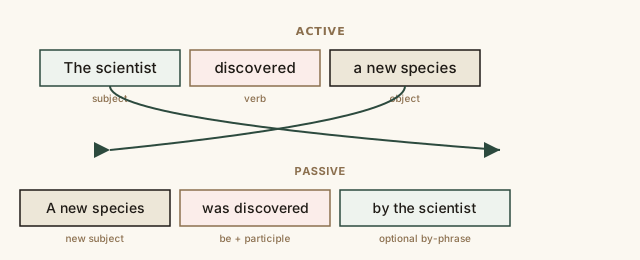
The arrows show exactly which sentence part moves where. Once this mechanical pattern is visible, spotting passive voice in your own writing becomes much faster: look for a form of "be" (is, was, were, has been) followed by a past participle (a verb ending in -ed or an irregular past-participle form like "written" or "broken").
Common mistakes
Common Mistakes
Believing passive voice is always grammatically wrong or should be eliminated entirely.
→ Recognize passive voice as a legitimate structure with real uses — the goal is deliberate choice, not zero passive sentences.
Confusing passive voice with past tense.
→ They're independent — 'she wrote the letter' is active past tense; 'the letter was written' is passive past tense; 'the letter is being written' is passive present tense. Voice and tense are two different grammatical dimensions.
Defaulting to passive voice out of habit in professional writing, making it sound vague or evasive.
→ When you notice a 'was/were + verb-ed' pattern, ask if naming the doer directly (switching to active) would make the sentence clearer and more direct.
Assuming shorter sentences are always active and longer ones are always passive.
→ Length isn't the test — check whether the subject is doing the action (active) or receiving it (passive), regardless of sentence length.
Common misconception
“Good writers never use passive voice — it should be eliminated wherever possible.”
Even celebrated writing style guides that recommend "prefer active voice" (like Strunk & White's The Elements of Style) explicitly acknowledge passive voice has legitimate uses, and professionally edited, well-regarded writing uses it regularly — in science, journalism, and formal reports especially. The actual rule experienced editors apply is: use active voice by default, and switch to passive specifically when the receiver of the action is more important to the sentence than the doer, or when the doer is unknown, obvious, or irrelevant. Treating "no passive voice, ever" as an absolute rule leads to awkward, unnatural sentences forced into an unnatural shape.
'The novel was written in 1925.' Is this passive voice used appropriately here?
What to do next
What to do next
- Scan a piece of your own recent writing for 'was/were + verb-ed' patterns and check whether each one is a deliberate choice or just a habit.
- Next time you write a headline or report a fact where the doer is unknown or irrelevant, notice that passive voice is often the more natural, not the 'wrong,' choice.
- In professional emails, try converting a passive sentence to active and compare which reads with more confidence and clarity.
- Read the related entry on Formal vs Informal Writing to see how voice choice interacts with register and tone more broadly.