 KnowThis
Key Takeaways
Key Takeaways
- 1The Indus Valley Civilization (c. 3300–1300 BCE) spanned a larger territory than ancient Egypt and Mesopotamia combined, across what is now Pakistan and northwest India.
- 2Its cities — especially Mohenjo-daro and Harappa — had grid-planned streets, covered drainage systems, and standardized brick sizes, a level of urban planning not matched again in the region for millennia.
- 3The Indus script, found on thousands of small stone seals, has never been deciphered — we can describe the civilization's cities and objects in detail, but we still can't read what its people wrote.
The concept
The most striking part of the Indus story isn't what we know — it's how much we still don't, starting with the writing system sitting on thousands of surviving objects that nobody today can read.
What makes the Indus Valley Civilization unusual compared to ancient Egypt and Mesopotamia?
Case studies
Case 1: Mohenjo-daro's drainage system (baseline case)
Case 2: The undeciphered Indus script (variation / open puzzle)
Case 3: Standardized weights and long-distance trade (real-world / applied case)
Why has the Indus script never been deciphered, unlike Egyptian hieroglyphics or Mesopotamian cuneiform?
How it works (visual)
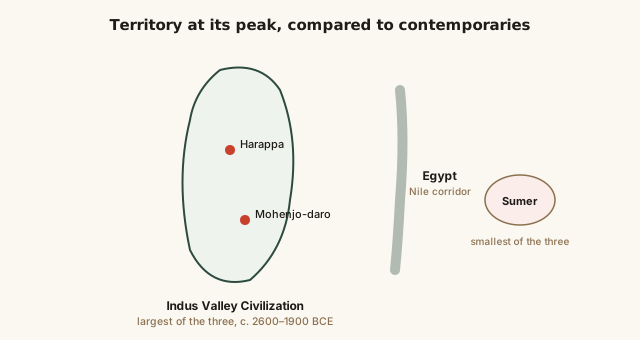
The scale is the point: the Indus Valley Civilization's territory dwarfed its better-known contemporaries, even though it remains far less familiar to most people today — largely because its writing still can't confirm names, kings, or events the way Egyptian and Mesopotamian texts can.
Common mistakes
Common Mistakes
Assuming the Indus Valley Civilization must have had kings and palaces like Egypt or Mesopotamia, just undiscovered.
→ Say plainly that the evidence for centralized royal power is genuinely absent, not just unfound — this is one of the real open questions researchers debate, not a settled fact either way.
Referring to the Indus script as "deciphered" or claiming a specific reading of it as established fact.
→ No decipherment is accepted by the broader scholarly community — treat any specific claimed "translation" you encounter online with real skepticism.
Calling it a minor or lesser ancient civilization compared to Egypt and Mesopotamia.
→ By territory and urban sophistication it was arguably the most advanced of the three — it's less "famous," not less significant, largely because we can't read its texts.
Common misconception
“The Indus Valley Civilization mysteriously vanished overnight, wiped out by some sudden catastrophe.”
Most current evidence points to a gradual decline over centuries (roughly 1900–1300 BCE), likely tied to shifting river courses and weakening monsoon patterns that undermined the agriculture the cities depended on, alongside a shift toward smaller, more dispersed settlements rather than a single dramatic collapse. Descendant populations and cultural elements persisted in the region rather than disappearing entirely.
What to do next
What to do next
- Next time someone lists "the cradles of civilization," check whether they include the Indus Valley alongside Egypt and Mesopotamia — it's earned the spot but often gets left out.
- If you see a claim that someone has "decoded" the Indus script, treat it skeptically — no reading is accepted by mainstream scholarship as of today.
- Look up a photo of an Indus seal online — the tiny scale of the inscriptions (often under 3 cm) makes the decipherment challenge much more concrete.