 KnowThis
Key Takeaways
Key Takeaways
- 1Antarctica is Earth's fifth-largest continent at about 14.2 million km², almost entirely covered by an ice sheet that holds roughly 90% of the world's ice and 70% of its fresh water.
- 2Despite the ice, Antarctica is technically the largest desert on Earth — desert status is defined by low precipitation, not temperature, and Antarctica's interior receives less snowfall annually than most hot deserts receive rain.
- 3No country owns Antarctica and it has no permanent residents or government of its own — it's managed cooperatively by around 54 parties to the Antarctic Treaty System, with a rotating research population of roughly 1,000 to 5,000 people depending on the season.
The concept
That combination — enormous ice mass but very little actual precipitation — is the single most counterintuitive fact about Antarctica's geography, and it's worth working through the numbers directly.
Antarctica is often classified by geographers as the largest desert on Earth. How can an ice-covered continent be a desert?
Worked examples
Example 1: Antarctica's share of Earth's land area (baseline case)
Example 2: Why Antarctica's average elevation is the highest of any continent (edge case / variation)
Antarctica has the highest average elevation of any continent, yet its tallest peak (Vinson Massif, 4,892 m) is far shorter than Asia's Everest (8,849 m). How can both be true?
Example 3: How the Antarctic Treaty actually governs a continent with no government (real-world / applied case)
Since the original Antarctic Treaty entered into force in 1961, roughly 54 countries — including the US, Russia, China, and every country with an active research presence — have agreed to a specific set of rules: no military activity, no nuclear testing or waste disposal, freedom of scientific research and open sharing of results, and a freeze on all territorial claims (several countries had made competing claims before 1959, and the treaty doesn't resolve them, it simply sets them aside). This is a genuinely unusual real-world governance model — instead of a national government, Antarctica runs on a multilateral treaty system that member nations enforce through mutual agreement and station-level cooperation, making it the only continent on Earth with no sovereign government, no permanent civilian population, and no economy in the ordinary sense.
How it works (visual)
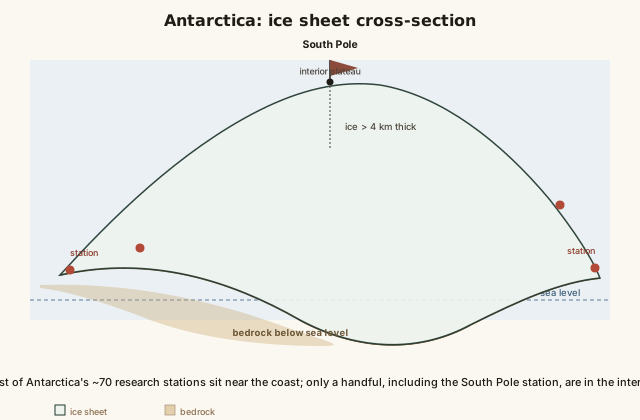
Notice how the bedrock line dips below sea level under the thickest ice — without that ice load, large parts of Antarctica's interior would actually be a shallow sea rather than dry land. Nearly all research stations sit near the coast, where supply ships and aircraft can reach them; only a handful, including the US Amundsen-Scott South Pole Station, operate year-round in the brutal interior.
Common mistakes
Common Mistakes
Assuming Antarctica is owned by whichever country runs the most research stations there.
→ No country owns Antarctica — the Antarctic Treaty System freezes all territorial claims and governs the continent cooperatively among roughly 54 member parties.
Thinking a continent covered in ice can't also be classified as a desert.
→ Desert status is based on low precipitation, not temperature or ice cover — much of Antarctica's interior receives less annual snowfall than the Sahara receives rain, making it the world's largest desert by land area.
Assuming Antarctica's tallest peak determines it has the highest average elevation, or vice versa.
→ These are different measurements: Vinson Massif (4,892 m) is far shorter than Everest, yet Antarctica's average elevation is the highest of any continent because of the sheer bulk of its ice sheet.
Common misconception
“Antarctica has no people or government at all — it's simply uninhabited and unclaimed.”
Antarctica has no permanent civilian population or sovereign national government, but it is not empty or ungoverned. Roughly 1,000 to 5,000 people live there at any given time, staffing around 70 research stations operated by dozens of countries, with the population peaking during the austral summer. It is governed — cooperatively, under the Antarctic Treaty System, which around 54 countries have signed since 1961, agreeing to keep the continent demilitarized, dedicated to scientific research, and free of new territorial claims. "No government" would be inaccurate; "no single national government" is the precise and correct statement.
Which statement about Antarctica's population and governance is accurate?
Try it yourself
What to do next
What to do next
- Use the calculator above with the winter population (about 1,000) versus the summer population (about 5,000) to see how dramatically Antarctica's already-tiny population density shifts by season.
- Compare Antarctica's average elevation (about 2,500 m) against Asia's (about 950 m) and connect the gap to ice-sheet thickness rather than mountain height.
- Look up which countries operate year-round Antarctic research stations and notice how the list spans nearly every continent.
- Read the related entry on the United Nations & Global Political Bodies to see how the Antarctic Treaty System compares to other multilateral governance structures.