Most of India's regional scripts, including Devanagari, Bengali, Tamil, and Telugu, descend from the ancient Brahmi script but evolved independently for well over a thousand years into genuinely distinct writing systems, most of them abugidas in which each consonant character carries a built-in default vowel.
Reading time
— 5 min
Updated
— Aug 16, 2026
Fact-reviewed
— Aug 16, 2026
Key Takeaways
Key Takeaways
1Most of India's major regional scripts — Devanagari, Bengali, Tamil, Telugu, Kannada, Malayalam, Gujarati, and others — descend from a single ancestor, the Brahmi script, first attested in fully developed form in Emperor Ashoka's 3rd-century-BCE rock edicts.
2Despite that shared root, over 2,000 years of independent evolution made these genuinely distinct, mutually unreadable writing systems today — not stylistic variants of one script, the way a font change would be.
3Nearly all of them are abugidas, not alphabets in the strict sense: each basic character represents a consonant plus a built-in default vowel, changed or removed with an attached mark rather than a separate vowel letter, the way English writes vowels.
The concept
India uses many different writing systems, not one. Devanagari writes Hindi, Marathi, Nepali, and Sanskrit. Bengali script writes Bengali and Assamese. Tamil, Telugu, Kannada, Malayalam, Gujarati, Gurmukhi (Punjabi), and Odia each have their own distinct script tied mainly to one language and region. Most of these look nothing alike on the page, but they share a common ancestor far enough back in history — the ancient Brahmi script — that linguists group them into one large script family, even though a reader literate in one generally can't read another without separately learning it.
With the abugida concept and the shared-Brahmi-ancestry point in mind, the individual scripts below are much easier to place — related, but genuinely their own systems.
Quick check
How does an abugida like Devanagari differ from an alphabet like English?
Worked examples
Example 1: Devanagari's structure (baseline)
Devanagari, used for Hindi, Marathi, Nepali, Sanskrit, and Konkani, has roughly 47 principal characters — about 33 consonants and 14 vowels — and its most visually distinctive feature is the horizontal headline (shirorekha) that runs across the top of most letters, visually joining the letters of a word into one connected unit on the page. It has been in continuous use since around the 7th century CE, reaching close to its current form by roughly the 11th century, and today it's used by an estimated 600 million or more people across the languages that share it.
Example 2: Tamil and Telugu as independent evolutions (variation / exception)
Tamil script traces its own separate line of descent from Brahmi, through Tamil-Brahmi and later the Pallava script, and looks strikingly different from Devanagari — no horizontal headline, and letterforms built almost entirely from curved, rounded strokes. That roundedness has a genuinely physical historical explanation: these scripts were long written with a stylus on dried palm leaves, and sharp, angular strokes tended to tear the leaf along the grain, so curved strokes became the practical, durable choice. Telugu, a separate Dravidian-language script also descended from Brahmi, shares that same rounded, curved letterform tradition and the same palm-leaf writing history, despite Telugu and Tamil belonging to the same Dravidian language family but having developed clearly distinguishable scripts of their own.
Example 3: Multiple scripts in daily civic life today (real-world / applied)
Road signs in many Indian states display place names in three scripts at once — the local regional script, Devanagari for Hindi, and the Roman alphabet for English — reflecting genuine everyday multi-script literacy rather than a single default writing system. Indian smartphone keyboards routinely ship with support for a dozen or more of these scripts as standard input options, since a single household or workplace can realistically involve several of them side by side.
Quick check
Why do Tamil and Telugu letterforms tend to be rounded and curved, without Devanagari's horizontal headline?
How it works (visual)
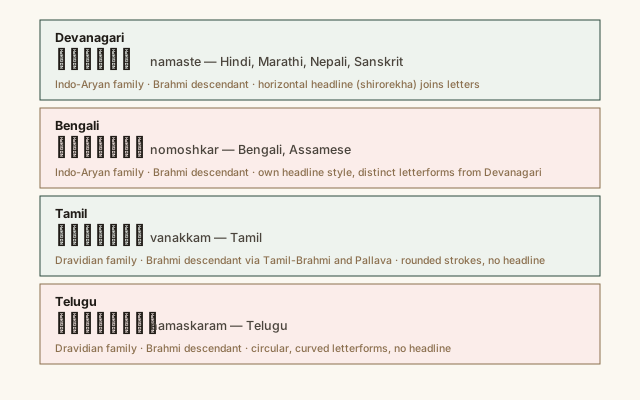
Four Indian regional scripts compared, all descended from Brahmi
Notice that two of these scripts (Devanagari and Bengali) write Indo-Aryan languages while the other two (Tamil and Telugu) write entirely unrelated Dravidian languages — a script family boundary and a language family boundary don't line up here, which is exactly the kind of distinction worth double-checking rather than assuming.
Common mistakes
Common Mistakes
✕
Assuming a script tells you a language's family.
→ Script and language family are independent facts — Urdu is Indo-Aryan (like Hindi) but is written in Perso-Arabic script, not a script shared with Hindi.
✕
Calling these writing systems 'alphabets' the way English is one.
→ Most are abugidas: each consonant carries a built-in default vowel, changed or removed by a mark, rather than vowels being separate letters.
✕
Treating regional scripts like Tamil or Telugu as recent, simplified spin-offs of Devanagari.
→ Both descend independently from Brahmi and have their own centuries-long, separate evolution — neither is a simplified version of the other.
Common misconception
“All Indian regional scripts are just stylistic variations of the same underlying writing system rather than genuinely distinct writing systems.”
They share a common ancestor — the Brahmi script, first attested in the 3rd century BCE — much the way the Latin and Cyrillic alphabets both ultimately trace back to the Phoenician alphabet. That shared ancestry doesn't make them interchangeable or "the same" system today. A fluent Devanagari reader generally cannot read Tamil or Bengali without separately learning that script from the ground up: each has its own character inventory, evolved independently for well over a thousand years, and in several cases represents a language from an entirely different family with its own distinct sound system.
Quick check
Someone claims Tamil script is 'basically the same as' Devanagari, just styled differently. What's the most accurate response?
What to do next
What to do next
Next time you see Indian currency or a road sign with multiple scripts, try to spot which ones you recognize and which language each belongs to.
Notice the horizontal headline in Devanagari text versus the more rounded, headline-free look of Tamil or Telugu.
Remember that a script and a language family are two separate facts — don't assume they always travel together, as with Urdu and Hindi.
Read Overview of Major Indian Languages to see how these scripts map onto India's language families and states.
FAQ
FAQ
Related terms
Related terms
Abugida
A writing system in which each basic character represents a consonant plus a default (inherent) vowel, with that vowel changed or removed by an attached mark rather than written as a separate letter — the pattern used by Devanagari, Bengali, Tamil, Telugu, and most other Indic scripts.
Brahmi script
The ancestor script of nearly all writing systems native to South Asia, first attested in fully developed form in the 3rd-century-BCE rock edicts of Emperor Ashoka. Devanagari, Bengali, Tamil, Telugu, and many other Indic and Southeast Asian scripts all descend from it.
Conjunct consonant
A single fused glyph formed when two or more consonants occur together with no vowel between them, rather than simply writing the base letters side by side — common in Devanagari, Telugu, and other Brahmi-descended scripts.
Inherent vowel
The default vowel sound (usually 'a') automatically carried by a consonant letter in an abugida unless a diacritic mark changes it or a special mark removes it entirely.
 KnowThis