 KnowThis
Key Takeaways
Key Takeaways
- 1Modern translation apps mostly use neural machine translation (NMT), which processes an entire sentence's context at once, not a word-by-word dictionary lookup.
- 2Translation quality still varies a lot by language pair and text type — high-resource language pairs (like English-Spanish) and casual text translate far better than low-resource languages or highly technical or legal documents.
- 3Idioms, ambiguous words, and culturally specific meaning remain the hardest cases for machine translation, because they depend on context a model may not have learned well.
The concept
With whole-sentence context as the key upgrade from older systems, it's worth seeing concretely what that does and doesn't fix — and where translation apps still reliably struggle.
What is the main difference between older word-substitution translation methods and modern neural machine translation (NMT)?
Worked examples
Example 1: A straightforward sentence that translates cleanly (baseline case)
Example 2: Idioms and ambiguous words — where literal translation breaks down (variation / exception)
Example 3: Real-time camera and conversation translation, and their current limits (real-world / applied case)
How it works (visual)
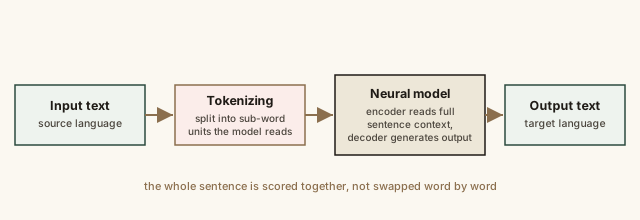
The key stage in this pipeline is the neural model in the middle — it's what separates modern context-aware translation from older word-by-word lookup systems, and it's also exactly where the model's training data quality determines how well a given language pair or type of text will translate.
Why do highly technical, legal, or low-resource-language documents tend to translate less reliably with translation apps?
Common mistakes
Common Mistakes
Assuming a translation app understands meaning the way a human bilingual speaker does.
→ Treat it as a highly capable statistical pattern-matcher trained on past translations, not as genuine language comprehension — useful, but with real limits on ambiguity and context.
Using a translation app for high-stakes documents like contracts, medical forms, or immigration paperwork without professional review.
→ Use a certified human translator for any document where a mistranslation would have legal, medical, or financial consequences.
Assuming all languages translate equally well through the same app.
→ Expect noticeably lower quality for less commonly translated ("low-resource") languages, since the model has seen far less bilingual training data for them.
Common misconception
“Translation apps translate word-for-word, swapping each word for its equivalent with no real understanding of context.”
This describes how much older rule-based and early statistical translation systems partly worked, not how modern neural machine translation operates. Today's systems process an entire sentence's context together to generate a translation, which is exactly why they handle word order, grammatical gender, and common idioms far better than literal word-for-word substitution ever could. That said, "whole-sentence context" is still statistical pattern-matching learned from data, not human-level comprehension — it can still fail on genuinely ambiguous, novel, or culturally specific language.
Someone claims: 'Translation apps just look up each word in a dictionary and swap it in — that's why they're modern.' Is this an accurate description of modern translation apps?
What to do next
What to do next
- Next time a translation app output sounds slightly "off," consider whether an idiom, ambiguous word, or cultural reference is the likely cause.
- For anything high-stakes (legal, medical, immigration, business contracts), plan on a human professional translator rather than relying on an app alone.
- When traveling, notice how much better translation apps handle common everyday phrases than specialized or regional slang.
- Read the related entry on AI and Language Processing Basics for how the underlying neural network technology behind translation apps actually generates language.