Social reformers and activists have driven lasting legal and cultural change outside of formal political office — figures like B. R. Ambedkar, who fought caste discrimination and helped draft India's constitution, Emmeline Pankhurst, who led the militant campaign for British women's suffrage, and Wangari Maathai, who founded Kenya's Green Belt Movement and became the first African woman to win the Nobel Peace Prize.
Reading time
— 5 min
Updated
— Aug 16, 2026
Fact-reviewed
— Aug 16, 2026
Key Takeaways
Key Takeaways
1Social reformers have driven lasting legal change without holding formal political office — B. R. Ambedkar, born into a caste historically classed as "untouchable," became independent India's chief architect of the constitution's caste-discrimination protections, chairing its drafting committee in 1947-49.
2The campaign for women's suffrage combined moderate lobbying and militant direct action — Emmeline Pankhurst's Women's Social and Political Union in Britain used hunger strikes, property destruction, and public confrontation to force the issue after decades of peaceful lobbying had made limited progress.
3Grassroots activism can scale into global environmental and human rights impact — Wangari Maathai's Green Belt Movement, started in Kenya in 1977 around community tree-planting, has since led to the planting of tens of millions of trees and won her the 2004 Nobel Peace Prize, the first awarded to an African woman.
The concept
Social reformers and activists work to change unjust laws, systems, or social norms, usually without holding formal political power themselves — instead, they build movements, shift public opinion, and pressure governments or institutions to act. This has taken many forms across history and geography: B. R. Ambedkar fought caste-based discrimination in India and helped write legal protections into the country's constitution; Emmeline Pankhurst led a militant campaign that helped win British women the right to vote; and Wangari Maathai built a Kenyan grassroots movement around tree-planting that grew into a globally recognized force for environmental protection and women's empowerment, work that won her the Nobel Peace Prize.
That shift from purely peaceful lobbying to direct, confrontational action is a recurring pattern across many reform movements in this entry — pressure that stays entirely comfortable for those in power rarely produces fast change on its own.
Quick check
What was B. R. Ambedkar's central role in shaping independent India?
Worked examples
B. R. Ambedkar and the drafting of India's constitution, 1947-49 (baseline case)
Ambedkar's path to influence ran through education and law rather than direct protest alone — after earning advanced degrees abroad despite significant caste-based obstacles at home, he became independent India's first law minister and chaired the Constitution Drafting Committee. The resulting 1950 constitution formally abolished "untouchability" and enshrined protections and affirmative-action provisions for historically disadvantaged castes, giving his reform work permanent legal force rather than relying solely on ongoing activism or public pressure.
Emmeline Pankhurst and militant British suffrage tactics (variation / confrontational case)
In contrast to Ambedkar's institutional, legal-reform approach, Pankhurst's Women's Social and Political Union (founded 1903) deliberately escalated tactics after decades of peaceful lobbying by earlier suffragists produced limited results. Members were arrested for window-breaking and public disruption, went on hunger strikes in prison, and endured force-feeding by British authorities — controversial, confrontational methods that historians credit with sustaining public and political attention on the issue until the Representation of the People Act 1918 granted the vote to British women over 30 (equalized with men's voting age in 1928).
Wangari Maathai and the Green Belt Movement (real-world / applied case)
Maathai, a Kenyan biologist, founded the Green Belt Movement in 1977 to address deforestation and soil erosion by organizing rural women to plant trees for a small payment — a practical, grassroots response to an environmental and economic problem. The movement grew to plant tens of millions of trees across Kenya and expanded into broader advocacy for women's empowerment, land rights, and government accountability, for which Maathai was repeatedly arrested and physically attacked by state security forces in the 1990s. In 2004, she became the first African woman awarded the Nobel Peace Prize, and the Green Belt Movement's tree-planting and civic-education model has since been directly replicated by environmental organizations in other countries, making it an actively applied template today, not just a historical example.
Quick check
How did Wangari Maathai's Green Belt Movement begin?
How it works (visual)
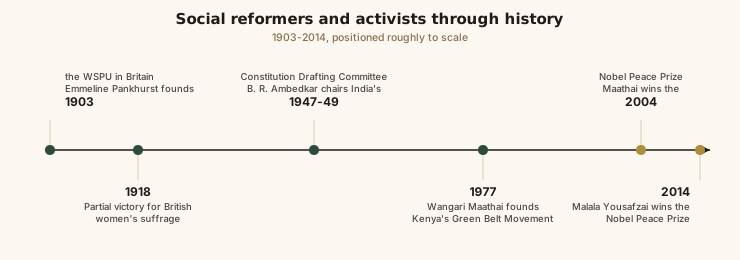
Timeline: social reformers and activists through history, 1900s-2000s
More than a century separates Pankhurst's founding of the WSPU from Malala Yousafzai's Nobel Prize, but each reformer on this timeline worked from outside formal political office to force lasting change — through law, through direct confrontation, or through sustained grassroots organizing.
Common mistakes
Common Mistakes
✕
Assuming social reformers always achieved change through peaceful lobbying alone.
→ Emmeline Pankhurst's suffrage campaign deliberately escalated to confrontational, sometimes law-breaking tactics after peaceful lobbying alone had produced limited results for decades.
✕
Treating reform movements as small, local efforts with no lasting large-scale impact.
→ Wangari Maathai's Green Belt Movement grew from local tree-planting into a movement responsible for planting tens of millions of trees and won its founder the Nobel Peace Prize.
✕
Assuming legal reform and grassroots activism are separate, unrelated categories of social change.
→ B. R. Ambedkar's activism directly fed into formal legal reform — his advocacy and legal training led him to chair the committee that wrote caste protections into India's constitution, showing how the two approaches can combine.
Common misconception
“Meaningful social reform only happens through official political leaders working within government.”
Many of history's most lasting reforms were driven substantially or entirely by people who never held formal political office. Emmeline Pankhurst was never an elected official — her outside-government campaign of civil disobedience is widely credited with helping secure the 1918 partial extension of voting rights to British women. Wangari Maathai's Green Belt Movement began as an entirely independent grassroots organization, at times in direct conflict with Kenya's government. B. R. Ambedkar did later hold formal roles, but his influence began through education, legal advocacy, and organizing outside established political power. Reform movements frequently create the pressure that then forces formal political change, rather than the other way around.
Quick check
Which statement best reflects how social reform has actually happened throughout history?
What to do next
What to do next
Next time you hear "peaceful protest" and "civil disobedience" used interchangeably, note that they aren't quite the same thing — Pankhurst's tactics moved deliberately into law-breaking territory that some contemporaries considered too confrontational.
When a modern environmental campaign uses grassroots, community-based organizing, notice the resemblance to Wangari Maathai's original Green Belt Movement model.
Look up which specific constitutional or legal protections in your own country trace back to a named reformer or activist, the way India's caste protections trace to Ambedkar.
Read the related entry on World Leaders Who Changed History to compare how formal political power and outside-government activism can each drive lasting change.
FAQ
FAQ
Related terms
Related terms
Suffrage
The right to vote in political elections; the suffrage movement fought specifically to extend voting rights to women, and in some countries, to other excluded groups.
Caste discrimination
Systemic social and legal disadvantage based on hereditary caste status, historically affecting Dalit communities in India, among others; the subject of much of B. R. Ambedkar's reform work.
Civil disobedience
The deliberate, public, and typically nonviolent violation of a law as a form of protest, intended to draw attention to and pressure change of an unjust policy.
Grassroots movement
A social or political movement that grows from ordinary community members and local organizing, rather than being directed from established political or institutional power.
 KnowThis