Scientists across every era and region have reshaped human understanding and everyday life — from Ibn al-Haytham's foundational work on optics and experimental method in 11th-century Iraq, to Marie Curie's discoveries in radioactivity, to Tu Youyou's 2015 Nobel Prize-winning malaria treatment drawn from traditional Chinese medicine.
Reading time
— 5 min
Updated
— Aug 16, 2026
Fact-reviewed
— Aug 16, 2026
Key Takeaways
Key Takeaways
1Foundational scientific thinking didn't begin with figures like Newton — 11th-century scholar Ibn al-Haytham, working in Basra and Cairo, is widely credited with pioneering the experimental, evidence-based approach now called the scientific method, centuries before European scientists formalized it.
2Marie Curie remains the only person to win Nobel Prizes in two different sciences (Physics in 1903 and Chemistry in 1911), for foundational work on radioactivity that led directly to modern cancer treatment and nuclear medicine.
3Scientific breakthroughs still draw directly on much older knowledge — Tu Youyou's 2015 Nobel Prize-winning discovery of the antimalarial drug artemisinin came from systematically researching a 1,600-year-old Chinese medical text, saving an estimated millions of lives from malaria since.
The concept
Scientists who "changed history" come from every era, region, and field — not just the familiar names most commonly taught in Western classrooms. Ibn al-Haytham, working in the Islamic Golden Age around the year 1000 CE, developed foundational methods of controlled experimentation and optics. Marie Curie, a Polish-French physicist and chemist, pioneered research into radioactivity in the early 1900s, work that eventually led to cancer treatments still used today. And Tu Youyou, a Chinese pharmaceutical chemist, discovered a life-saving malaria drug in the 1970s by systematically investigating traditional Chinese medicine texts — work that wasn't recognized with a Nobel Prize until 2015, decades after her original discovery.
That still-radioactive notebook is a small but vivid reminder that the risks these scientists took to build foundational knowledge were often genuinely physical, not just intellectual.
Quick check
What is Ibn al-Haytham most credited with pioneering?
Worked examples
Ibn al-Haytham and the "Book of Optics," c. 1021 CE (baseline case)
Working in Basra and later Cairo during the Islamic Golden Age, Ibn al-Haytham used controlled experiments, including devices resembling a camera obscura, to test and ultimately overturn the long-standing theory that human vision worked by the eye emitting rays. His seven-volume "Book of Optics" documented these experiments methodically enough that historians of science, including several who have called him "the father of modern optics," credit his approach as a direct forerunner of the modern experimental scientific method, roughly six centuries before figures like Francis Bacon and Galileo formalized similar principles in Europe.
Marie Curie and the discovery of radioactivity, 1898-1911 (variation / barrier-breaking case)
Working with her husband Pierre Curie, Marie Curie discovered two new radioactive elements, polonium and radium, isolating radium from tons of a uranium-ore byproduct called pitchblende under grueling, hazardous lab conditions. She became the first woman to win a Nobel Prize (Physics, 1903, shared with Pierre and Henri Becquerel), and remains the only person in history to win Nobel Prizes in two different scientific fields, adding a Chemistry prize in 1911 for isolating pure radium. Her research laid the groundwork for radiation therapy in cancer treatment, still a standard medical technique used worldwide today.
Tu Youyou and the discovery of artemisinin (real-world / applied case)
In the early 1970s, as part of a secret Chinese government program (Project 523) searching for new malaria treatments during the Vietnam War era, chemist Tu Youyou systematically reviewed thousands of traditional Chinese medical texts and remedies. A roughly 1,600-year-old text describing a cold-water extraction method for sweet wormwood (Artemisia annua) led her to isolate artemisinin, now a core component of the World Health Organization's recommended standard malaria treatment worldwide. Tu Youyou tested the compound on herself before wider human trials, and her work — largely uncredited internationally for decades — was finally recognized with the 2015 Nobel Prize in Physiology or Medicine, making her the first mainland Chinese laureate in a science category.
Quick check
Where did Tu Youyou's key insight for discovering artemisinin come from?
How it works (visual)
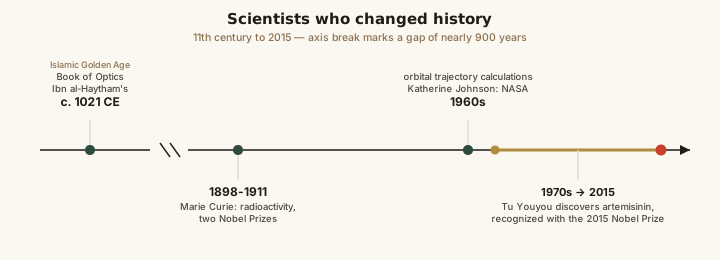
Timeline: scientists who changed history, 11th century to today
Nearly a thousand years separate Ibn al-Haytham's experiments from Tu Youyou's Nobel Prize, but the throughline is consistent: each breakthrough came from rigorous, repeatable evidence-gathering, whether that evidence came from a controlled optics experiment, painstaking isolation of a radioactive element, or systematic review of a centuries-old medical text.
Common mistakes
Common Mistakes
✕
Assuming the scientific method was invented in Europe during the Scientific Revolution (16th-17th century).
→ Ibn al-Haytham's rigorously experimental approach in 11th-century Iraq and Egypt predates the European Scientific Revolution by roughly six centuries and is widely credited by historians of science as a direct forerunner of it.
✕
Treating scientific breakthroughs as if they always come from entirely new discoveries with no historical basis.
→ Tu Youyou's Nobel Prize-winning malaria drug came directly from systematically investigating a 1,600-year-old traditional Chinese medical text — a reminder that older knowledge and modern experimental rigor can combine to produce genuinely new breakthroughs.
✕
Assuming recognition for scientific work always arrives at the time of discovery.
→ Tu Youyou made her key discovery in the early 1970s but wasn't awarded the Nobel Prize for it until 2015 — over four decades later — a reminder that scientific recognition, especially across language and political barriers, can lag significantly behind the actual work.
Common misconception
“Major scientific breakthroughs have historically come almost exclusively from Western Europe and North America.”
Foundational scientific work has come from every major world region across history. Ibn al-Haytham's pioneering experimental work in optics took place in 11th-century Iraq and Egypt during the Islamic Golden Age, centuries before similar methods were formalized in Europe. Tu Youyou's Nobel Prize-winning malaria treatment came from Chinese state-sponsored research combining traditional medicine with modern chemistry in the 1970s. C.V. Raman, an Indian physicist, won the 1930 Nobel Prize in Physics for discovering the scattering effect on light that bears his name. Treating scientific progress as a purely Western story leaves out substantial, well-documented contributions from across Asia, the Middle East, and elsewhere.
Quick check
Which of these best reflects the actual geographic spread of major historical scientific breakthroughs?
What to do next
What to do next
Next time "the scientific method" comes up as a purely European invention, mention Ibn al-Haytham's 11th-century experimental work as a documented earlier example.
Notice when a modern drug or treatment traces back to traditional or historical knowledge, the way artemisinin traces back to a 1,600-year-old Chinese text — it's a more common pattern in medical history than people often assume.
When you hear about a scientist's Nobel Prize, check how many years passed between their key discovery and the award — the gap is sometimes decades, as with Tu Youyou.
Read the related entry on World Leaders Who Changed History to see how scientific and political change have often unfolded on very different timelines.
FAQ
FAQ
Related terms
Related terms
Scientific method
A systematic approach to inquiry involving observation, hypothesis, controlled experimentation, and verifiable evidence — its early form is credited substantially to Ibn al-Haytham's 11th-century work on optics.
Radioactivity
The spontaneous emission of energy or particles from unstable atomic nuclei; a term coined by Marie Curie, who conducted foundational research into the phenomenon.
Artemisinin
An antimalarial compound isolated by Tu Youyou from the sweet wormwood plant, based on a traditional Chinese medical text — now a core component of standard malaria treatment worldwide.
Peer review
The process of having scientific work evaluated by independent experts in the same field before publication or wider acceptance, a cornerstone of how scientific claims are validated today.
 KnowThis