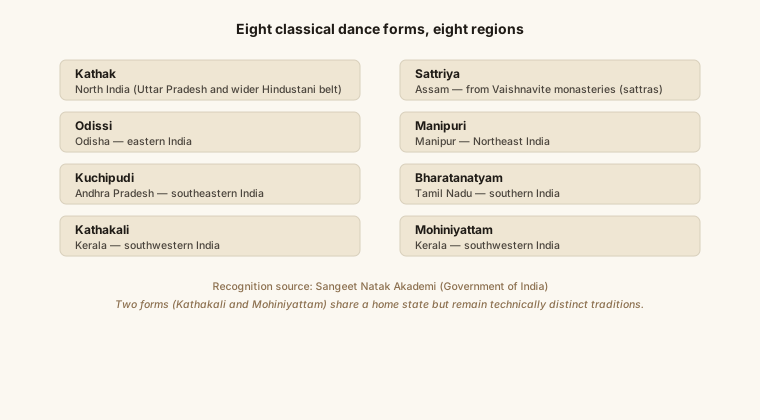
Classical Indian dance is not a single tradition but a family of eight regionally distinct, formally codified performance styles — Bharatanatyam, Kathak, Odissi, Kathakali, Manipuri, Kuchipudi, Mohiniyattam, and Sattriya — each recognized by India's national academy for the performing arts.
Reading time
— 4 min
Updated
— Aug 16, 2026
Fact-reviewed
— Aug 16, 2026
Key Takeaways
Key Takeaways
1India's national academy for the performing arts formally recognizes eight classical dance forms, each tied to a specific region, with its own technique, repertoire, and training lineage — not one shared style with regional costumes.
2What makes a dance form 'classical' rather than 'folk' in this context is a documented technical treatise, a codified grammar of movement and gesture, and a continuous teacher-to-student (guru-shishya) transmission — not simply age or popularity.
3Several forms look outwardly similar to an untrained eye (elaborate costume, bells, hand gestures) but differ sharply in footwork, storytelling method, and origin — Bharatanatyam and Kathak, for instance, come from opposite ends of the subcontinent and developed under very different historical influences.
The concept
"Classical Indian dance" is not one dance — it's a family of eight distinct, formally recognized styles, each from a different part of India: Bharatanatyam (Tamil Nadu), Kathak (North India), Odissi (Odisha), Kathakali (Kerala), Manipuri (Manipur), Kuchipudi (Andhra Pradesh), Mohiniyattam (Kerala), and Sattriya (Assam). Each has its own costume, music, hand gestures (mudras), and stories it tells, and dancers train for years under a single teacher before performing in public.
Quick check
What formally distinguishes a 'classical' Indian dance form from a folk dance, according to the Sangeet Natak Akademi's criteria?
Worked examples
Example 1: Bharatanatyam — the baseline case
Bharatanatyam, from Tamil Nadu, is the form most people picture first: precise geometric poses, a fixed repertory sequence (margam) that moves from pure rhythmic dance into expressive storytelling, and a solo female dancer accompanied by Carnatic vocal music, a mridangam drummer, and a nattuvanar who recites the rhythm aloud. It traces its documented lineage to temple dancers (devadasis) and was codified into its modern performance structure in the early 20th century by the Tanjore Quartet. Training typically culminates in an arangetram, a dancer's formal debut solo performance after years of study.
Example 2: Kathakali — a stylistic exception
Kathakali, from Kerala, breaks the "solo female dancer" pattern entirely: it's historically an all-male, elaborately masked and costumed dance-drama, with performers wearing towering headdresses and painted faces (green for noble characters, red-and-white beards for the villainous) to enact scenes from the Mahabharata and Ramayana over an entire night. Its footwork and body training draw directly from Kalaripayattu, a Kerala martial art, giving it a physically explosive quality that contrasts sharply with Bharatanatyam's more contained geometry — proof that "classical Indian dance" covers genuinely different movement philosophies, not one aesthetic with regional decoration.
Example 3: Classical dance today — the applied case
These forms are actively practiced, not preserved as museum pieces: dance academies (natyalayas) across India and in diaspora cities from London to Chicago train new generations toward an arangetram, the Sangeet Natak Akademi awards annual fellowships to senior practitioners, and choreographers regularly stage new works within a form's traditional vocabulary rather than only reviving historical repertoire. Bharatanatyam and Kathak sequences also turn up choreographed into Indian film and television, which is often where non-specialist audiences see the technique first, even though the staged and screen versions are usually compressed and reworked from the full classical repertoire.
Quick check
Which classical form's technique is most directly rooted in a Kerala martial art?
The eight classical dance forms and their state of origin
Common mistakes
Common Mistakes
✕
Referring to any elaborately costumed Indian dance performance as 'Bharatanatyam.'
→ Bharatanatyam is one of eight distinct forms — check the accompanying music, footwork style, and costume against the specific form's known conventions before naming it.
✕
Assuming all eight forms are equally ancient.
→ Their codification dates vary widely — Sattriya wasn't formally recognized as classical until 2000, even though the monastic tradition it draws from is centuries old.
✕
Treating Bollywood or stage-adapted dance sequences as an accurate full representation of a classical form.
→ Screen and stage adaptations are usually shortened, stylized excerpts — the full classical repertoire (margam, for example, in Bharatanatyam) is a much longer, structured sequence rarely shown in full outside a dedicated recital.
Common misconception
“All Indian classical dance is basically 'the same style' — colorful costumes and hand gestures with regional names attached.”
The eight recognized forms differ in fundamental ways: Bharatanatyam's geometric solo technique, Kathakali's all-male masked dance-drama rooted in a martial art, Kathak's spins and rhythmic footwork shaped by both Hindu temple and Mughal court traditions, and Odissi's sculpture-inspired poses are genuinely distinct systems of training, storytelling, and music — not variations on one shared choreography. Treating them as interchangeable is roughly equivalent to calling ballet, flamenco, and tap "basically the same" because they're all staged Western dance.
Quick check
Why is it inaccurate to describe the eight classical Indian dance forms as 'regional versions of the same dance'?
What to do next
What to do next
Next time you watch an Indian classical dance clip online, check the description for which of the eight forms it is — the technique and story-telling method genuinely differ.
Notice the accompanying music: Bharatanatyam, Kuchipudi, and Mohiniyattam use Carnatic (South Indian) music, while Kathak uses Hindustani (North Indian) music — a quick way to place a performance regionally.
If you see an all-male, heavily masked dance-drama performed over a full night, that's very likely Kathakali, not a generic 'temple dance.'
Look up whether a dance academy or event near you specializes in a specific classical form before assuming a general 'Indian dance' class covers all eight equally.
FAQ
FAQ
Related terms
Related terms
Natya Shastra
The ancient Sanskrit treatise on dramatic and performing arts, traditionally attributed to the sage Bharata, that underlies the technique and aesthetic theory of most classical Indian dance forms.
Mudra
A stylized hand gesture used in classical Indian dance to convey specific words, objects, or ideas as part of a codified visual vocabulary.
Abhinaya
The art of expressive storytelling in Indian dance and theatre, conveyed through facial expression, gesture, and body movement rather than words.
Sangeet Natak Akademi
India's national academy for music, dance, and drama, established in 1952, which formally recognizes eight classical dance forms and sets criteria distinguishing classical from folk traditions.
 KnowThis